
McHenry County, IL — Fall Furnace Tune-Up
Furnace Tune-Up in
McHenry County, IL
★★★★★
5.0 · Google reviews ↗
A fall furnace tune-up does two things: keeps the system from failing on the coldest night, and verifies it isn't leaking carbon monoxide. Airwave covers burner cleaning, flame sensor and igniter service, and inducer and pressure-switch testing — plus combustion analysis with CO measurement and a full heat-exchanger inspection on every visit. No commission on any repair found.
14-point checklist
Combustion analysis every visit
Heat exchanger inspection
Written report every visit
Best scheduled September through October — before McHenry County's first cold snap arrives without warning in late October or early November.
Illinois HVAC License
#PF1C707231CB6F1L0 ↗
On Every Visit
Combustion Analysis
Google Reviews
5.0 · Verified ↗
Every Visit
14-Point + Report
Headquartered
Lake in the Hills, IL
The Full Checklist
What a Fall Furnace Tune-Up Includes — 14-Point Inspection
Every Airwave furnace tune-up follows the same documented checklist, anchored by the two safety items most maintenance skips: combustion analysis and heat-exchanger inspection. Every reading is recorded in your written report.
Combustion Analysis — CO, CO₂, O₂ Flue Measurement
Calibrated analyzer reads flue gases to confirm complete combustion and safe CO levels. Included on every visit — not an upgrade.
Heat Exchanger Visual Inspection
All accessible surfaces inspected for cracks, corrosion, and separation at joints and welds — the component that keeps combustion gases out of your air.
Burner Cleaning & Flame Pattern Inspection
Ports cleaned, flame verified blue and stable — yellow streaking flags incomplete combustion and elevated CO.
Flame Sensor Cleaning
Oxidation layer removed from the sensing rod — prevents the most common "lights then shuts off in 30 seconds" no-heat symptom.
Igniter Inspection & Condition Rating
Visual inspection for cracks and erosion. A borderline igniter flagged in October is an elective replacement; the same igniter failing in January is an emergency.
Gas Valve Operation & Pressure Check
Manifold gas pressure verified against manufacturer spec. Valve confirmed to open and close cleanly without stuttering.
Inducer Motor Amp Draw & Pressure Switch
Inducer motor current measured. Induced-draft pressure switch operation verified — a failed switch causes a no-ignition lockout.
Blower Motor Amp Draw
Indoor blower motor current measured at operating voltage. Elevated draw or sluggish start indicates bearing wear or a failed run capacitor.
All Capacitors Tested to Microfarad Spec
Blower and inducer capacitors tested against rated value. More than 6% below spec gets flagged and discussed with the homeowner.
Limit Switch Verification
High-limit and rollout limit switches tested. Repeated tripping signals airflow restriction — often a dirty filter, blocked return, or undersized duct.
Flue Vent & Combustion Air Inspection
Vent joints inspected for separation or corrosion; combustion air supply verified unobstructed. On high-efficiency units, PVC vent integrity and condensate trap confirmed.
Condensate Drain Inspection & Clearing
On high-efficiency furnaces, the condensate trap and line are checked and cleared — biofilm buildup is a recurring mid-winter lockout cause.
Air Filter Inspection & Change-Interval Guidance
Filter condition assessed and replaced if needed. McHenry-County-specific interval given by system type, MERV rating, and seasonal conditions.
Written Report With All Findings & Measurements
Documented record for warranty protection, insurance, and homeowner reference — every combustion reading and amp draw, not just a checkmark.
Looking for a furnace tune-up near you that actually checks combustion safety? Most don't run a combustion analysis or inspect the heat exchanger — Airwave does both on every visit. (773) 849-7379.
Carbon Monoxide Safety
Combustion Analysis & Heat Exchanger Inspection — Why They're on Every Fall Tune-Up
Most HVAC maintenance in McHenry County does not include combustion analysis. Every Airwave fall furnace tune-up does. Here's what it measures, what it detects, and why it's the part of the visit that matters most.
What Combustion Analysis Actually Measures
A calibrated combustion analyzer is inserted into the furnace flue and reads three gas concentrations to confirm the furnace is burning fuel completely and safely:
CO
Carbon monoxide in parts per million. Below 50 ppm in the flue is normal; well-tuned furnaces run under 20 ppm.
CO₂
Carbon dioxide as a percentage. The 9–12% range indicates efficient, complete combustion.
O₂
Oxygen as a percentage. The 5–8% range confirms the correct air-to-fuel mixture.
A furnace producing 200–400 ppm CO in the flue is burning incompletely — a sign of a dirty burner, a combustion-air problem, or a developing fault. Without an analyzer, none of this is visible: the furnace still lights, still produces heat, and gives no outward sign that anything is wrong.
The most critical reading is CO in the supply air stream — the air actually being circulated through your home. Any measurable CO there indicates combustion gases are crossing the heat exchanger barrier into your living space, which is precisely the condition combustion analysis exists to catch.
Heat Exchanger Failure: What It Looks Like & What We Do
The heat exchanger is the metal component that separates the combustion chamber from the air-supply plenum. When it develops a crack, hole, or joint separation, combustion gases — including carbon monoxide — can mix into the air your family breathes. It's the single most serious failure a furnace can have.
Visual inspection during the fall tune-up reaches all accessible heat-exchanger surfaces, looking for cracks — often hairline fractures near stress points and weld seams — corrosion, and separation. Combined with the supply-air CO reading from the combustion analysis, this is how a compromised heat exchanger is caught before it becomes dangerous.
If a compromised heat exchanger is found, we explain exactly what was found, show you the measurement data, and provide honest repair-versus-replace numbers. On most aging furnaces, a cracked heat exchanger means the system should not be operated until it's replaced — and we'll tell you that plainly, with no commission riding on the recommendation.
If Your CO Detector Is Alarming Right Now — This Is a 911 Call, Not a Tune-Up
If your carbon monoxide detector is going off, or anyone in the home has unexplained headaches, dizziness, or nausea while the furnace runs, get everyone out of the home immediately and call 911 from outside. A tune-up is preventive; an active CO event is an emergency. After emergency services confirm it's safe to re-enter, then call us for diagnosis.
Why Fall Timing Matters
What Makes a McHenry County Furnace Tune-Up Worth Doing Before Winter
McHenry County's first significant cold snap typically arrives in late October or early November — without much warning. A furnace that's been idle since spring gets its first hard run exactly when a failure is most dangerous. Fall maintenance moves you ahead of that.
🔥
Caught Early
The Igniter Math
A borderline igniter flagged during a fall tune-up can be replaced at your convenience during the same visit — a planned, low-cost part. The same igniter failing at 10 PM on the coldest night of January is a no-heat emergency call, at after-hours rates, with the house dropping below freezing while you wait.
Fall is when a $200 elective replacement prevents a 2 AM crisis.
🛡️
Safety First
CO Risk Peaks in Winter
A furnace runs hardest and longest in deep winter — which is exactly when a developing heat-exchanger crack or combustion fault produces the most carbon monoxide, and when the house is sealed tightest against the cold. Verifying combustion safety in the fall, before that load arrives, is the entire point of the timing.
The combustion analysis and heat-exchanger inspection turn an invisible winter risk into a documented fall reading.
📅
Scheduling
Beat the First Cold Snap
Scheduling in September or October gives three advantages over November: the best appointment availability before the rush, time to handle any repair found calmly rather than as an emergency, and certainty that the system is ready before the first hard freeze rather than during it.
Once the first cold snap hits, the same calendar fills with no-heat emergencies competing for every slot.
🌬️
Local Factor
Filter Intervals for Heating Season
Standard guidance says change the filter every 90 days. In McHenry County, many homes need it every 45–60 days during heating season (November–February) — a restricted filter trips the high-limit switch, short-cycles the furnace, and accelerates blower wear.
The fall tune-up sets a system-specific interval based on MERV rating and your home's conditions, so the furnace breathes properly all winter.
Scope & Transparency
What the Furnace Tune-Up Price Includes — and What It Doesn't
No bait-and-switch. Here's exactly what the flat tune-up price covers, and what would be quoted separately with a written estimate before any work begins.
Included in the Tune-Up Price
- All cleaning, inspection & testing labor
- Combustion analysis & written report
- Heat exchanger visual inspection
- Flame sensor cleaning
- Condensate drain inspection & clearing (high-eff.)
- All capacitor microfarad & motor amp readings
- Filter change-interval guidance
Quoted Separately (With Written Estimate)
- Replacement parts (igniter, capacitor, sensor, etc.) — written estimate first
- Air filter — you supply, or we supply at cost
- Repairs beyond tune-up scope — always priced before proceeding
- Duct cleaning or sealing — separate service
Tune-Up vs. Repair — Which Do You Need?
A tune-up is preventive — scheduled maintenance to keep a working furnace running safely and catch problems early. If your furnace is already not heating, short-cycling, or locked out, that's a repair, not a tune-up. For an active no-heat problem, see furnace repair for same-day diagnostics. The tune-up prevents; the repair fixes.
Transparent Pricing
Furnace Tune-Up Cost in McHenry County, IL
Flat, predictable tune-up pricing. The bundled annual plan — which adds the spring AC tune-up — costs less than booking the two visits separately. Final pricing confirmed before scheduling.
Single fall furnace tune-up — full 14-point checklist + combustion analysis + report
$99 – $159
Annual plan — fall furnace + spring AC tune-up bundled
~$219/yr
Multi-system / rental property — per system
Custom quote
Flame sensor replacement (if flagged) — common fall find
$80 – $200
Hot-surface igniter replacement (if flagged)
$150 – $300
Capacitor replacement (if flagged)
$120 – $250
- The tune-up price is flat — all cleaning, inspection, combustion analysis, and testing labor is included regardless of how long it takes.
- Combustion analysis and heat-exchanger inspection are part of the standard price, not a "premium" add-on — most competitors charge extra or skip them entirely.
- Any repair found is presented with a written estimate before work begins, and Airwave earns no commission on it — what's flagged is what the readings show.
- Plan members receive a discount on repairs found, plus priority scheduling during the fall rush. For full plan options, see the HVAC maintenance plans page.
Furnace Tune-Up Near Me in McHenry County — What to Expect
When a McHenry County homeowner searches for a furnace tune-up, the difference that matters is whether the visit includes a real combustion-safety check or is just a quick filter-and-flame look. Most maintenance in the area does not run a combustion analysis or inspect the heat exchanger — Airwave does both, on every fall visit, with every reading recorded in a written report. That's the difference between knowing your furnace is safe and assuming it.
The no-commission structure matters most on the safety side. A technician paid on what they sell has an incentive to over-flag a heat exchanger; a technician who earns the same regardless reports the actual combustion readings and shows you the data. If the CO reading is clean, you'll see the number. If the heat exchanger is compromised, you'll see that too — with honest repair-vs-replace math and no pressure. Airwave covers the fall furnace tune-up across all of McHenry County and adjacent Kane County communities, with a 5.0 rating across 47 verified Google reviews.
Pair the fall furnace tune-up with the spring AC tune-up under one annual plan for complete year-round coverage at a lower combined cost.
Licensed & Insured Maintenance
Who Performs Your Furnace Tune-Up
Airwave Heating and Cooling is a professional HVAC contractor headquartered in Lake in the Hills, IL. Founder and principal technician Igor Talmazan performs every tune-up personally.
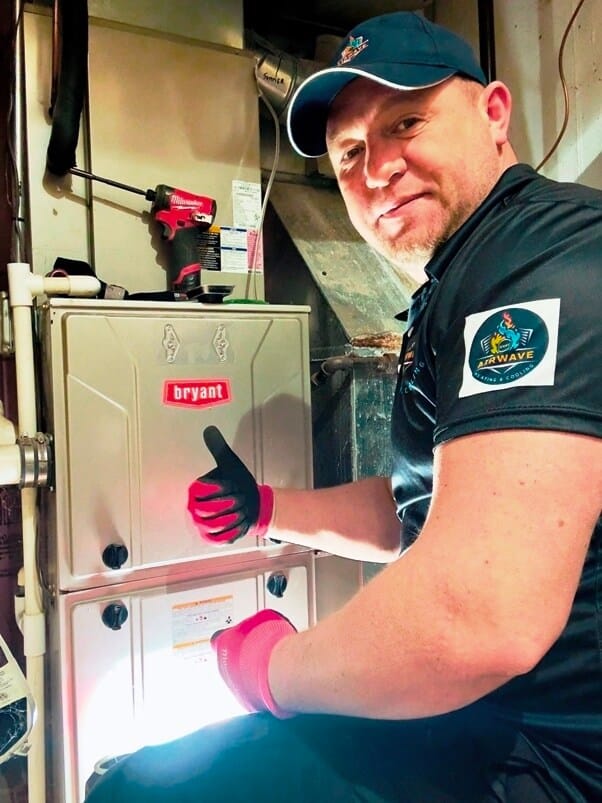
Founder & Principal Technician
Igor Talmazan
HVAC Contractor & Founder · Airwave Heating and Cooling
Igor performs every furnace tune-up personally. The single thing that sets an Airwave fall tune-up apart is that combustion analysis and heat-exchanger inspection happen on every visit — not as a "premium" tier, not as an upsell, but as the standard. Most maintenance in McHenry County skips the combustion analyzer entirely, which means the one failure mode that can actually harm a family — carbon monoxide crossing a cracked heat exchanger — goes unchecked for an entire heating season. That's the gap this tune-up is built to close.
Airwave earns no commission on repairs found. On the safety side this matters enormously: a commissioned technician has an incentive to over-flag an expensive heat-exchanger replacement, while a technician who earns the same regardless simply reports the combustion readings and shows you the data. If the numbers are clean, the report says so. If they're not, you see exactly why — with honest repair-versus-replace math and no pressure.
- Combustion analysis on every fall tune-up — not an upgrade
- Heat exchanger inspection standard, with borescope when needed
- Illinois HVAC Contractor License — statewide, McHenry & Kane counties
- 14-point checklist with every reading documented
- No commission on repairs found — readings drive the report
- Fully insured residential HVAC operations
IL HVAC License: #PF1C707231CB6F1L0 · Direct technical contact at (773) 849-7379. Fall furnace tune-up scheduling opens in September.
Fast Track Service
Schedule Furnace Tune-Up in McHenry County
Share a few details and we'll call you back to confirm your appointment — usually within the hour. Or skip the form: (773) 849-7379
Request Received!
We'll call you back shortly to confirm your appointment.
For an emergency during the heating season, don't wait — call us now.
Your information is used only to schedule your service call — never shared or sold.
Complete HVAC Service in McHenry County
The fall tune-up is one half of a complete maintenance program — and the same technician handles repairs and the spring AC visit too.
AC Tune-Up
The spring companion to this visit — coil cleaning, refrigerant check, and capacitor testing before cooling season.
AC Tune-Up →Furnace Repair
Already no heat? Same-day gas furnace diagnostics and repair, with combustion analysis on every call.
Furnace Repair →Maintenance Plans
Bundle both seasonal tune-ups into one annual plan — lower combined cost, priority scheduling, repair discount.
Maintenance Plans →Ready to Book Your Fall Furnace Tune-Up?
Beat the first cold snap — book in September or October for a relaxed appointment and combustion safety verified before heating season. Written report every visit, no commission-driven upsells.
Common Questions
Furnace Tune-Up FAQ — McHenry County, IL
Answers to the questions homeowners ask most about fall furnace maintenance and combustion safety. For plan and pricing questions, see the maintenance plans page.
September through October — before McHenry County's first cold snap, which typically arrives without much warning in late October or early November. Scheduling early means any repair found can be handled calmly rather than as a no-heat emergency, you get the best appointment availability before the rush, and combustion safety is verified before the furnace runs hard all winter. Airwave's fall schedule opens in September. An off-season tune-up is still worthwhile if fall slipped by — but the safety value is highest before heating season begins.
A visual inspection alone can miss the most dangerous problem. A furnace with a developing heat-exchanger crack or a combustion fault still lights, still produces heat, and gives no outward sign anything is wrong — it can be producing elevated carbon monoxide while looking completely normal. A calibrated combustion analyzer reads the actual flue gases (CO, CO₂, O₂) and, critically, measures CO in the supply air your family breathes. That's the only way to confirm combustion gases aren't crossing the heat exchanger into your home. Most maintenance in McHenry County skips this entirely; Airwave includes it on every fall tune-up because it's the part that actually protects the household.
A cracked heat exchanger is often invisible without inspection — that's what makes it dangerous. Warning signs include a CO detector alarming (evacuate and call 911 first), soot or corrosion around the furnace, a flame that flickers or changes color when the blower kicks on, a strong chemical odor during operation, and unexplained headaches or nausea among household members that improve away from home. But the most reliable detection isn't visual symptoms — it's the combination of a borescope/visual heat-exchanger inspection and a supply-air CO measurement, both included in the fall tune-up. If a crack is confirmed, the furnace should not be operated until it's replaced, and you'll get the measurement data and honest repair-vs-replace numbers with no commission riding on the recommendation.
A tune-up is preventive maintenance on a furnace that's still working — cleaning, testing, measuring, and verifying combustion safety to keep it running and catch problems before they cause a failure. A repair addresses a furnace that's already malfunctioning: no heat, short cycling, locked out, or alarming. If your furnace isn't heating right now, you need furnace repair with same-day diagnostics, not a tune-up. The tune-up's whole purpose is to prevent the repair — and to catch the safety issues that don't announce themselves — but once something has actually failed, it's a repair call.
Yes — for two reasons. First, the failures that strand homeowners in January (a worn igniter, a fouled flame sensor, a drifting capacitor, a clogged condensate trap) are invisible until they hit under load, and a furnace that ran fine last winter is a year closer to all of them. Second, and more important, combustion safety isn't something you can feel: a heat exchanger can develop a crack between seasons, and the only way to know is to measure. A furnace "working fine" tells you it produces heat — it tells you nothing about whether it's producing carbon monoxide. The fall tune-up confirms both performance and safety, and documents it in writing for your warranty and records.
Airwave provides fall furnace tune-ups across all of McHenry County — Lake in the Hills, Crystal Lake, Algonquin, Huntley, Cary — plus adjacent Kane County communities including Carpentersville and Fox River Grove, under a statewide Illinois HVAC license. From the Lake in the Hills home base, most addresses are a short drive. If you're searching "furnace tune-up near me" from a McHenry or Kane County address, call (773) 849-7379 to confirm coverage and book a fall slot before the first cold snap.
Last reviewed: June 2026 · EPA 608 refrigerant phase-out dates, repair pricing ranges, and IL HVAC licensing verified current.