
McHenry County, IL — Same-Day AC Repair
AC Repair in
McHenry County, IL
★★★★★
5.0 · Google reviews ↗
Airwave provides licensed residential AC repair throughout McHenry County — same-day for standard calls, 24/7 emergency response. Illinois-licensed and EPA 608 Universal certified for every residential refrigerant (R-22, R-410A, R-454B), with an itemized written estimate before any work begins.
Same-Day AC Repair
24/7 Emergency
R-22 · R-410A · R-454B
All Major Brands
Illinois HVAC License
#PF1C707231CB6F1L0 ↗
Federal Certification
EPA 608 Universal
Google Reviews
5.0 · Verified ↗
Headquartered
Lake in the Hills, IL
Response Time
Same-Day · 24/7 Emergency
HVAC Brands We Service:
Carrier
Lennox
Trane
Goodman
Rheem
Bryant
American Standard
York
Daikin
Symptom Guide
Signs Your Air Conditioning Needs Repair — Act Now vs. Schedule Soon
Some AC problems require same-day air conditioning repair — especially during a McHenry County heat wave. Others can safely wait 24–48 hours. Here's how to triage what you're seeing, and what to do right now to avoid making the problem worse.
Call Now — Same-Day
These Signs Mean Call Today
- AC running continuously but home won't cool below 80°F+ — during an Illinois heat wave with high humidity, indoor heat becomes a health risk for elderly residents, infants, and pets within hours.
- AC unit not turning on at all — no sound, no airflow. Most common cause: failed capacitor or tripped disconnect. Both can be diagnosed and fixed same-day.
- Ice or frost on refrigerant lines or indoor coil — switch to Fan Only immediately and call. Do not run a frozen system; you risk destroying the compressor.
- Burning electrical smell or melting plastic odor — shut the system off at the disconnect and call immediately. Electrical component failure is a fire risk.
- AC tripping the circuit breaker repeatedly — each restart on a failing component draws a current spike that turns a $150 capacitor repair into a $1,200 compressor replacement.
- Water leaking from the indoor unit — a blocked condensate drain that overflows can damage ceilings, drywall, and flooring within hours. Turn the system off and call.
Schedule Within 24–48 Hours
These Can Safely Wait Briefly
- Cooling capacity dropping over the past few days — system still cools, but takes longer to reach setpoint. Often a slow refrigerant leak or coil fouling.
- Short cycling (5–10 minute on/off intervals) — usually a low refrigerant charge, oversized system, or failing thermostat. Wear on the compressor accumulates; schedule promptly.
- High humidity despite cool air — AC is undersized, oversized, or refrigerant charge is off-spec. Indoor humidity above 60% damages woodwork and feels worse than the actual temperature.
- Unusual noises — humming, rattling, grinding — outdoor fan motor or compressor mount issues. Schedule before it becomes a hard failure.
- Energy bill spike of 30%+ without a usage change — system is running inefficiently. Common causes: dirty coil, clogged filter, low refrigerant, failing capacitor.
- Musty or moldy smell when AC turns on — biological growth on the evaporator coil or in the condensate pan. Affects indoor air quality; schedule a coil cleaning.
Diagnostic Guide
Common AC Problems in McHenry County — What's Wrong & What Fixes It
Most air conditioning failures fall into recognizable patterns. This guide connects the symptom you're experiencing to its most probable cause and the typical AC repair that resolves it. Use it to triage before you call.
AC Won't Turn On — No Response at All
Most likely cause: Failed run capacitor — the single most common AC repair in Illinois summers. Heat accelerates capacitor degradation.
Secondary causes: tripped circuit breaker, faulty contactor, failed thermostat, or a blown fuse at the disconnect box.
What to check first: Reset the breaker once. Confirm thermostat is set to COOL, fan to AUTO, setpoint below room temp. If still won't start, call — capacitors store a lethal charge and must be tested by a licensed technician.
CapacitorContactorElectrical
AC Running But Not Cooling
Most likely cause: Low refrigerant from a leak. The system runs and moves air, but there isn't enough refrigerant pressure to produce meaningful cooling.
Other causes: dirty condenser coil shedding heat inefficiently, frozen evaporator coil blocking airflow, or a failed compressor that isn't actually compressing refrigerant.
Important: Adding refrigerant without finding and fixing the leak is both a regulatory violation (EPA 608) and a waste of money. We find the leak first, always.
RefrigerantCompressorCoil
AC Freezing Up — Ice on Lines or Coil
Two root causes, very different fixes:
(1) Airflow restriction — a clogged filter, closed supply registers, or a failing blower motor starves the evaporator coil of warm air. The coil gets too cold and freezes. Fix: restore airflow.
(2) Low refrigerant — insufficient refrigerant causes suction pressure to drop below the freezing point of moisture on the coil. Fix: find and repair the leak, then recharge.
What to do: Switch to Fan Only to defrost, change the filter, and call for diagnosis. Running a frozen system risks compressor damage.
AirflowRefrigerantCoil
AC Short Cycling (On/Off Every 5–10 Minutes)
Most likely cause: Low refrigerant charge — the system reaches a low-pressure cutoff and shuts down, then restarts when pressure normalizes.
Other causes: oversized system (cycles off because thermostat is satisfied quickly), failing capacitor causing motor strain, dirty condenser coil overheating, faulty thermostat with poor temperature differential.
Why it matters: Short cycling accelerates wear on the compressor — the most expensive component in the system. Diagnose promptly to prevent a $200 fix from becoming a $2,200 one.
RefrigerantSizingCompressor
Water Leaking From Indoor Unit
Most likely cause: Clogged condensate drain line. Algae and biofilm build up over a season; the line overflows from the drain pan when blocked.
Other causes: failed condensate pump, cracked drain pan, frozen-then-thawed evaporator coil dumping accumulated water, dirty air filter restricting airflow.
What to do: Switch the system off to prevent ongoing water damage to ceilings, drywall, and floors. Place a towel under the unit and call — most drain line clears are same-day, $80–$150.
CondensateDrainPump
AC Tripping the Circuit Breaker
Most likely cause: Failing compressor drawing excess current on startup, or a shorted contactor causing a current spike.
Other causes: damaged wiring (rodent or weather damage), failing capacitor causing the motor to lock up, ground fault in the outdoor unit, or undersized breaker (rare).
Do not repeatedly reset the breaker — each reset draws another current spike. A single reset is fine; repeated trips mean call now. Compressor damage compounds with every restart attempt.
ElectricalCompressorWiring
What We Fix
Air Conditioning Repair Services — McHenry County, IL
Central air conditioning systems involve multiple interdependent components. Below is a complete breakdown of every AC repair we handle — what causes each failure, what the repair involves, and typical cost ranges for McHenry County service calls.
Capacitor & Contactor Replacement
Run and start capacitors are the most frequently replaced components in a central AC system — they live inside a hot outdoor unit exposed to Illinois summers. A failing run capacitor causes the compressor or fan motor to struggle, draw excess current, and eventually stall. The contactor is the high-voltage relay that powers the compressor and outdoor fan — pitted or welded contacts cause the system not to start.
We always test capacitor microfarad value against spec before recommending replacement. A capacitor reading within 5% of its rated value isn't the problem, and we won't tell you it is.
Capacitor: $80–$180 · Contactor: $80–$160Refrigerant Leak Detection & Recharge
A system low on refrigerant cannot produce adequate cooling regardless of how well everything else is working. Refrigerant does not "wear out" — if your system is low, there is a leak. Under EPA 608 regulations, adding refrigerant without repairing the leak first is a regulatory violation.
We locate leaks using electronic detection and UV dye, repair them, and recharge to manufacturer specification. R-22 (legacy), R-410A (current standard), and R-454B (new 2025+ equipment) all serviced in-house.
Leak repair + recharge: $150–$600+ by refrigerant typeCompressor Diagnosis
The compressor is the heart of the AC system — and the most expensive component. A failed compressor often costs more to replace than the rest of the system combined. We diagnose compressor condition using electrical testing (winding resistance, megohm testing for insulation integrity), pressure analysis, and current draw measurement.
If the compressor has failed on a system 10+ years old, the math typically favors replacement — we provide both numbers openly.
Diagnosis: $89 trip + diagnostic | Replacement: $800–$2,200+Condenser Fan Motor Replacement
The outdoor fan motor moves air across the condenser coil to release heat absorbed from inside your home. When it fails, refrigerant pressure climbs above design limits and the compressor either trips on high-pressure cutoff or overheats. PSC and ECM variants in stock for most major brands.
Often paired with a capacitor — the run capacitor that powers the fan is the most common reason for fan motor failure.
Motor: $250–$500 · ECM variants: higherEvaporator Coil Cleaning & Repair
The indoor evaporator coil absorbs heat from your home's air. When fouled with dust, biofilm, or refrigerant oil, cooling capacity drops significantly. We perform deep-clean service using approved coil cleaner and verify post-cleaning airflow and temperature differential.
Refrigerant leaks at the evaporator coil are common on systems 12+ years old — when an evaporator coil leak is confirmed on an aging system, replacement of the coil (or full air handler) is often more economical than repair.
Cleaning: $150–$350 · Replacement: $600–$1,400+Condenser Coil Cleaning
The outdoor coil rejects heat absorbed by the refrigerant. Cottonwood, grass clippings, leaves, and dirt accumulate every Illinois summer — McHenry County's June cottonwood season is particularly heavy. A dirty condenser coil forces refrigerant pressure above design limits and accelerates compressor wear.
Spring condenser cleaning is the single most impactful preventive measure available for residential AC in this area. We recommend annual cleaning, ideally in April or early May.
Cleaning: $120–$250Control Board & Thermostat Diagnosis
Modern AC systems use an electronic control board to coordinate compressor, fan, and safety circuit operation. When a board fails, symptoms can mimic many other problems. We test the board's outputs and verify continuity before recommending replacement — boards are expensive and frequently misdiagnosed as the cause by less rigorous service approaches.
Thermostat issues (failed calibration, dead batteries, wiring problems) are eliminated before any control-board diagnosis begins.
Thermostat: $150–$350 · Control board: $350–$700Blower Motor & Indoor Air Handler Service
The indoor blower moves conditioned air through your home's ductwork. Symptoms of blower issues include reduced airflow at registers, unusual noise, or system tripping high-limit safety switches. We service PSC standard motors and ECM variable-speed motors for all major brands.
A failing blower motor often presents identically to a clogged filter or restricted ductwork — proper diagnosis distinguishes one from the other and prevents replacing a working motor.
PSC: $300–$650 · ECM: $450–$900TXV / Metering Device Diagnosis
The thermal expansion valve (TXV) regulates refrigerant flow into the evaporator coil. When it fails — typically stuck open or stuck closed — cooling capacity drops dramatically and refrigerant pressures move out of design range.
TXV diagnosis requires correlating multiple measurements: superheat, subcooling, suction pressure, and discharge pressure. A failed TXV is often misdiagnosed as a refrigerant problem; we verify the metering device before recommending refrigerant work.
TXV replacement: $300–$600Electrical & Wiring Diagnosis
Loose connections, corroded terminals, rodent-damaged wiring, and failed disconnect-box fuses cause symptoms that can mimic any number of component failures. We start every electrical diagnosis at the disconnect box and trace through to the unit terminals.
Most "intermittent" AC problems trace back to a single bad connection. Identifying and correcting that connection is the difference between a real repair and a return visit two weeks later.
Diagnosis: $89 trip + diagnostic · Repair: varies24/7 Emergency Air Conditioning Repair
Heat-related AC failures during Illinois summer heat advisories receive priority dispatch any hour, any day. Health-priority routing applies to homes with elderly residents, infants, or anyone with heat-sensitive medical conditions.
Direct technical contact at every step — no call-center routing, no callback queue. After-hours rates are stated upfront before dispatch, never added afterward.
After-hours rates disclosed upfrontPrevent Most AC Repairs With Annual Spring Maintenance
Most of the AC repairs catalogued above are preventable through annual spring maintenance — typically scheduled in April or early May before cooling season begins. Maintenance includes capacitor microfarad testing, refrigerant pressure verification, condenser coil cleaning, evaporator coil inspection, and condensate drain treatment.
Spring maintenance pricing and the full multi-point inspection checklist are detailed on the HVAC Maintenance hub page.
Refrigerant Guide
Understanding Refrigerant in Your Air Conditioning System
The refrigerant in your AC system is the fluid that makes cooling possible. The type your system uses matters significantly for AC repair costs and the repair-vs-replace decision — especially for older McHenry County homes where equipment installed before 2010 uses refrigerant that is no longer manufactured.
R-22
Also called: Freon® · HCFC-22
Used in virtually all central AC equipment manufactured before approximately 2010. Production of R-22 was fully phased out in the United States as of January 1, 2020 under the EPA Clean Air Act. The remaining supply is reclaimed from decommissioned systems — supply is limited and shrinking, which means prices are high and continue to rise.
If your system is losing R-22, the cost of refrigerant alone can make replacement more economical than repeated recharges.
Phase-out complete · Limited supplyR-410A
Also called: Puron® · AZ-20
The standard refrigerant for residential AC equipment from approximately 2010 through 2024. R-410A is not being manufactured in new equipment as of January 1, 2025 under EPA regulations, though existing R-410A systems can still be repaired with reclaimed refrigerant.
If your system was installed between 2010 and 2024, it almost certainly uses R-410A. Supply is currently adequate, but prices will rise as reclaimed supply becomes the only source.
Current standard · RepairableR-454B
Also called: Puron Advance® · R-32 blend
The current refrigerant standard for all new residential AC equipment manufactured from January 1, 2025. R-454B is a low-GWP refrigerant with a slightly lower operating pressure than R-410A. Equipment manufactured for R-454B cannot use R-410A as a substitute — the systems are designed specifically for the new refrigerant.
Any new central AC system installed today in McHenry County will use R-454B.
New standard · 2025+ equipment
For McHenry County homeowners with older AC systems: Airwave is fully certified under EPA 608 Universal for all three refrigerant types. When we recommend repairing vs. replacing an R-22 or R-410A system that has a refrigerant leak, the cost of refrigerant is part of the math — and we present both numbers openly. R-22 phase-out economics are a real factor in repair-vs-replace decisions for pre-2010 equipment, not a sales tactic.
Transparent Pricing
AC Repair Cost in McHenry County, IL
Central air conditioning repair costs vary significantly by component. The ranges below reflect typical costs for McHenry County service calls. A written estimate is always provided before any work begins — you approve the cost before we proceed. No surprises.
Disconnect fuse replacement
$40 – $80
Capacitor replacement (run or start) — most common AC repair in Illinois summers
$80 – $180
Contactor replacement
$80 – $160
Condensate drain clearing
$80 – $150
Condenser coil cleaning
$120 – $250
24V transformer replacement
$100 – $200
Thermostat replacement (supplied by us)
$150 – $350
Refrigerant leak repair + recharge (R-410A)
$150 – $600+
Refrigerant recharge only — R-22 (reclaimed)
$300 – $800+ by quantity
Evaporator coil cleaning
$150 – $350
Condenser fan motor replacement
$250 – $500
TXV replacement
$300 – $600
Blower motor — PSC standard
$300 – $650
Control board replacement
$350 – $700
Blower motor — ECM variable-speed
$450 – $900
Evaporator coil replacement
$600 – $1,400+
Compressor replacement
$800 – $2,200+
- These are ranges, not flat rates. Exact AC repair costs depend on equipment brand, model, component accessibility, and parts availability.
- R-22 refrigerant is significantly more expensive than R-410A due to limited reclaimed supply. Factor this into the repair-vs-replace conversation for pre-2010 McHenry County equipment.
- A written estimate with itemized part and labor costs is provided before any work begins. No surprises on the invoice.
- After-hours rates apply to calls after 6 PM, before 8 AM, and weekends/holidays. Disclosed upfront before we come out — never added after the fact.
- When a repair cost approaches or exceeds the threshold for replacement, we tell you with both numbers. Airwave does not earn commissions on equipment sales.
Decision Guide
When to Repair vs. Replace Your Air Conditioning System
Most air conditioning problems are worth repairing. But certain combinations of age, refrigerant type, and repair cost make replacement a smarter investment. Here's how to evaluate the decision clearly — with honest numbers, not sales pressure.
Recommend Repair
AC Repair Is Usually the Right Call When
- System is under 12–14 years old and repair cost is less than one-third of a comparable new system
- System uses R-410A and refrigerant recharge cost is not prohibitive
- Failed component is an inexpensive serviceable part — capacitor, contactor, sensor, drain line, fan motor
- Compressor tests in-spec — mechanical compressor failure is not confirmed
- System has been reliable with no pattern of repeated component failures this season
- System is properly sized for the home — replacement with same-size equipment would not solve any performance issues
Discuss Replacement
Consider Replacement When
- System is 15+ years old and facing a major repair (compressor, coil replacement)
- System uses R-22 and refrigerant recharge cost alone makes total repair cost prohibitive
- Compressor has failed and system is more than 10 years old — replacement often costs as much as a new outdoor unit with warranty
- Multiple major components have failed in the same cooling season
- System is consistently undersized for the home — new Manual J load calculation reveals an opportunity to right-size
- R-22 parts are becoming difficult to source on older discontinued equipment
The Age-Threshold Framework
How to Evaluate Repair vs. Replacement in McHenry County
Residential central AC systems have a typical service life of 14–18 years in Illinois, where equipment runs hard from late May through September. For systems under 12 years old with no history of major component failures, AC repair is almost always the right call.
For systems 14 years and older, the conversation shifts: repair still makes sense if the cost is under $400–$500 and the refrigerant is R-410A. A system 15+ years old with a failed compressor ($800–$2,200+) or a leaking evaporator coil ($600–$1,400+) that also uses R-22 — the repair math no longer works in the homeowner's favor, and a real conversation about replacement options is the honest path forward.
Airwave does not earn commissions on equipment replacement. The recommendation is driven by the numbers, not the invoice.
Technical Standards
Our Diagnostic Protocol — Step by Step
Every service call follows the same documented diagnostic protocol established by Airwave's founder and principal technician. This is the technical depth behind a typical service experience — we identify the root cause, not just the failed component, so the same problem doesn't recur next season.
01
System Operation Interview
We start by asking when the symptom started, how the system behaved before failure, what changed (recent filter change, storm, first run of the season), and whether any error codes appeared on the thermostat. These details narrow the diagnostic path before we touch anything.
02
Electrical Measurements — Indoor & Outdoor
Voltage and amperage at the disconnect box and contactor terminals, capacitor microfarad readings, transformer output, and fuse continuity. These measurements take 10–15 minutes and identify most common failures (capacitor, contactor, fuse, wiring) immediately.
03
Refrigerant Pressure Check
If the system is running but not cooling adequately, we connect manifold gauges to the service valves and measure suction and discharge pressure. These readings tell us the charge level, compressor efficiency, and whether the metering device is functioning correctly — all in a single step.
04
Airflow & Coil Inspection
We check filter condition, supply and return grille status, blower motor current draw, and evaporator coil condition (including whether it is iced, fouled, or has visible refrigerant oil traces indicating a coil leak). Airflow problems are often the root cause of apparent refrigerant and compressor symptoms.
05
Leak Detection (If Refrigerant Low)
If the system is undercharged, we locate the leak before adding any refrigerant. Electronic leak detector on all accessible refrigerant circuit components; UV dye injection for leaks that don't produce an immediate electronic signal. No refrigerant is added until the leak is found and repaired.
06
Written Estimate & Same-Visit Repair
We explain the diagnosis in plain language and provide a written estimate with itemized part and labor costs before starting any work. Most AC repairs are completed in the same visit because common parts are stocked on the service vehicle — capacitors, contactors, fan motors, control components, condensate pumps, and R-22/R-410A/R-454B refrigerants.
Service Area
Air Conditioning Repair by Community — McHenry County, IL
Each McHenry County community Airwave serves has its own housing era, climate factors, and dominant AC failure patterns. The map shows the primary service area; each city card links to a dedicated AC repair page with city-specific local insights and pricing.
Lake in the Hills, IL
Home BaseAirwave's headquarters. The 1990s building boom produced a concentration of systems now 25–30 years old, often using R-22 refrigerant. Aging capacitors, condenser coil clogging from local cottonwood, and Woods Creek Lake humidity are the dominant service patterns.
Lake in the Hills AC repairCrystal Lake, IL
Largest CityThe county's largest city and highest-volume AC repair area. Lake-effect humidity drives longer run cycles and faster component wear. Housing spans pre-war downtown bungalows through 2000s subdivisions — the full repair spectrum in a single ZIP area.
Crystal Lake AC repairAlgonquin, IL
Two-CountyTwo-county village (McHenry & Kane) along the Fox River and Randall Road corridor. Western 2000s subdivisions are now entering their first major repair cycle; older eastern neighborhoods face flood-zone and humidity considerations.
Algonquin AC repairCary, IL
+ Fox River GroveFox River Valley town along the Metra Union Pacific Northwest Line. Wide housing age range from 1890s riverfront properties to 1990s subdivisions. Rail vibration affects refrigerant-line connections in homes near the station. Fox River Grove also served.
Cary AC repairHuntley, IL
Sun CityWestern prairie community. Home to Del Webb Sun City — one of Illinois' largest 55+ active-adult communities. Drier prairie microclimate, but wind-driven agricultural debris affects condenser coil performance. Health-priority response for elderly households during heat advisories.
Huntley AC repairCarpentersville, IL
Oldest HousingHistoric industrial company town with the most diverse housing age range in the area. Pre-war worker cottages through 1990s builds, with significant pre-1960 housing requiring specialized AC retrofit knowledge. Eastern blocks border the Fox River.
Carpentersville AC repairIn a surrounding McHenry County or adjacent Kane County community not listed above?? Reach Airwave directly at (773) 849-7379 — coverage and timing for your specific address is confirmed before scheduling.
Licensed & Insured AC Repair
The Standards Behind Every Airwave AC Service Call
Airwave Heating and Cooling is a professional HVAC contractor headquartered in Lake in the Hills, IL. Founder and principal technician Igor Talmazan establishes the diagnostic standards, refrigerant-handling protocols, and quality bar that govern every AC repair performed under the Airwave name.
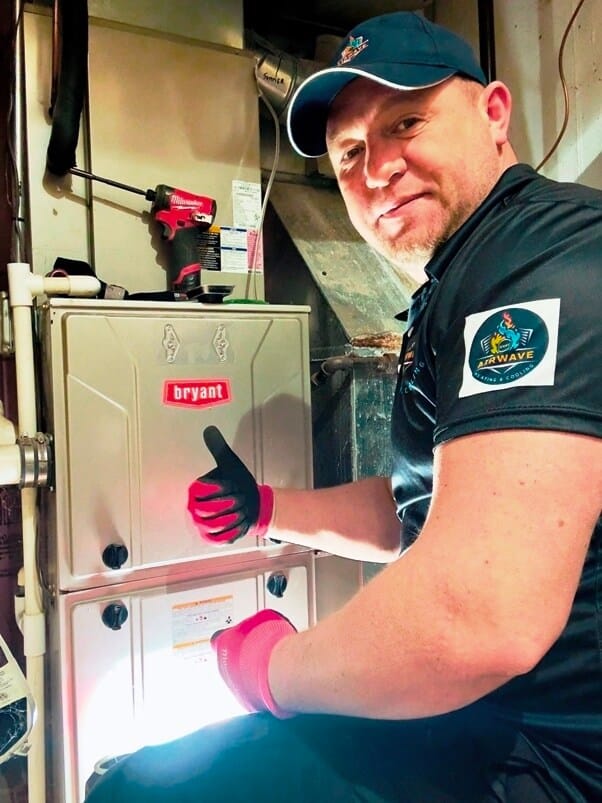
Founder & Principal Technician
Igor Talmazan
HVAC Contractor & Founder · Airwave Heating and Cooling
Airwave's AC repair work is performed personally by Igor Talmazan — an Illinois-licensed HVAC contractor with EPA 608 Universal certification, qualified to recover, repair, and recharge every refrigerant currently in residential service: R-22 (legacy), R-410A (the standard from 2010 through 2024), and R-454B (the new 2025+ standard). Many local operators carry only Type II certification, which limits them to high-pressure refrigerants and rules out work on older R-22 systems entirely. Universal credentials matter when a pre-2010 McHenry County system needs actual refrigerant management — not bypassed recovery, not blind recharging, not punted to another contractor.
Every AC service call follows a documented diagnostic protocol that emphasizes refrigerant management, electrical-component testing, and root-cause identification before any work is approved. The compensation structure does not change between a $200 capacitor repair and a $5,200 system replacement — the recommendation is driven by what the equipment actually needs, not by which option produces the larger invoice. Combined with stocked parts for the brands prevalent in McHenry County homes, this produces a single-visit repair rate that is the working definition of what Airwave is known for.
- Illinois HVAC Contractor License — verifiable through IDFPR public lookup
- EPA Section 608 Universal Certification — qualified for R-22, R-410A, R-454B, and all system sizes
- Fully insured residential HVAC operations across McHenry County
- Written itemized estimate before any AC repair work begins — never surprises on the invoice
- No commission on equipment sales — repair-vs-replace recommendations driven by the math
- Common parts stocked on the service vehicle — capacitors, contactors, fan motors, control components, condensate pumps, all three current refrigerants
IL HVAC License: #PF1C707231CB6F1L0 · Service area: Lake in the Hills, Crystal Lake, Algonquin, Cary, Huntley, Carpentersville, and surrounding McHenry County communities.
Fast Track Service
Schedule AC service in McHenry County
Share a few details and we'll call you back to confirm your appointment — usually within the hour. Or skip the form: (773) 849-7379
Request Received!
We'll call you back shortly to confirm your appointment.
For an emergency during the heating season, don't wait — call us now.
Your information is used only to schedule your service call — never shared or sold.
Other HVAC Services in McHenry County
Same licensed technician, same direct service — across all HVAC needs.
Furnace Repair
Same-day gas furnace diagnostics and repair. Heat exchanger inspection with combustion analysis included on every call.
Furnace Repair →AC Installation
New central air conditioning sized to actual cooling load. R-454B-ready installations for 2025+ standard compliance.
AC Installation →HVAC Maintenance
Spring AC tune-ups that prevent the repairs catalogued above. Multi-point inspection and refrigerant verification on every visit.
HVAC Maintenance →Ready to Schedule AC Repair in McHenry County?
Same-day service for non-emergencies, 24/7 dispatch for heat-advisory failures. Direct technical contact — no call-center routing.
Common Questions
Frequently Asked Questions — AC Repair in McHenry County
Honest answers to the questions McHenry County homeowners ask most about AC repair, refrigerant management, and what to expect on a service call.
The most common cause is low refrigerant from a leak — the system runs and moves air, but there isn't enough refrigerant pressure to produce meaningful cooling. Other likely causes: a dirty condenser coil (heat can't be rejected efficiently), a frozen evaporator coil (blocks airflow), or a failed compressor (the system runs but doesn't actually compress refrigerant). Under EPA 608 regulations, we locate and repair the leak before adding any refrigerant — blind recharging is both a regulatory violation and a waste of money since the refrigerant will leak out again.
Two root causes, very different fixes. Airflow restriction — a clogged filter, closed supply registers, or a failing blower motor starves the evaporator coil of warm air. The coil gets too cold and freezes. Low refrigerant — insufficient refrigerant causes suction pressure to drop below the freezing point of moisture on the coil. Switch the system to Fan Only immediately to defrost, replace the filter, and call for diagnosis. Running a frozen system risks compressor damage.
Common repair ranges: capacitor replacement $80–$180, contactor $80–$160, condensate drain clearing $80–$150, refrigerant leak repair + R-410A recharge $150–$600+, blower motor $300–$650 (PSC) or $450–$900 (ECM), compressor replacement $800–$2,200+. R-22 refrigerant is significantly more expensive than R-410A due to limited reclaimed supply, which factors into the repair-vs-replace conversation for pre-2010 equipment. A written itemized estimate is provided before any work begins. See the full pricing table above for all repair types.
Most likely cause: a failing compressor drawing excess current on startup, or a shorted contactor causing a current spike. Other causes include damaged wiring (rodent damage or weather degradation), a failing capacitor causing the motor to lock up, a ground fault in the outdoor unit, or an undersized breaker (rare). Do not repeatedly reset the breaker — each reset draws another current spike, and compressor damage compounds with every restart attempt. One reset is fine; repeated trips mean call now.
No — that's short cycling, and it accelerates wear on the compressor (the most expensive component). Most likely cause is low refrigerant charge: the system reaches a low-pressure cutoff and shuts down, then restarts when pressure normalizes. Other causes include an oversized system (cycles off because the thermostat is satisfied too quickly), a failing capacitor, a dirty condenser coil causing overheating, or a faulty thermostat. Schedule prompt diagnosis to prevent a $200 fix from becoming a $2,200 one.
Most likely cause: a clogged condensate drain line — algae and biofilm build up over a season and the line overflows from the drain pan when blocked. Switch the system off to prevent ongoing water damage to ceilings, drywall, and floors. Place a towel under the unit and call. Most condensate drain clears are same-day, $80–$150. Other causes include a failed condensate pump, cracked drain pan, or a recently-thawed evaporator coil dumping accumulated water.
For systems under 12–14 years old with no history of major component failures, repair is almost always the right call. For systems 14+ years old, the calculation shifts: repair still makes sense if cost is under $400–$500 and refrigerant is R-410A. A 15+ year old system with a failed compressor ($800–$2,200+) or leaking evaporator coil ($600–$1,400+) that also uses R-22 — replacement math typically favors a new system. Airwave provides both numbers openly and earns no commission either way. See the full decision framework above.
Yes. 24/7 emergency response is available throughout McHenry County for AC failures during heat advisories. Direct line to a licensed technician at (773) 849-7379 — no call-center routing, no callback queue. After-hours rates are stated upfront before dispatch, never added to the invoice afterward. Health-priority routing applies to households with elderly residents, infants, or anyone with heat-sensitive medical conditions.
Yes — Airwave is EPA 608 Universal certified to service R-22 systems with reclaimed refrigerant. The economic question is more nuanced. R-22 production was phased out in 2020 and remaining supply is reclaimed from decommissioned systems, so prices are high and rising. Recharging an R-22 system that has a leak is increasingly expensive: $300–$800+ for recharge alone depending on quantity. If your R-22 system is 14+ years old and the refrigerant cost alone approaches the cost of a new system installation, replacement usually makes economic sense. We provide both numbers openly. See the refrigerant guide above.
Annual spring maintenance is the right cadence for residential AC in this area — typically scheduled in April or early May before cooling season begins. Spring tune-ups catch the components most likely to fail during summer (capacitor approaching microfarad spec, refrigerant approaching low-charge threshold, condenser coil approaching the cottonwood-clog point) before they actually fail at noon in July. Maintenance pricing and the full inspection checklist are detailed on the HVAC Maintenance hub page.
Airwave services all major residential AC brands — Carrier, Lennox, Trane, Goodman, Rheem, Bryant, American Standard, York, Daikin, Comfortmaker, Heil, and Coleman, among others. Brand is not a limitation. Common parts for the brands prevalent in McHenry County homes — capacitors, contactors, condenser fan motors, control boards, and refrigerants for R-22, R-410A, and R-454B systems — are stocked on the service vehicle, so the majority of repairs are completed in a single visit without sourcing parts.
High indoor humidity with a running AC usually means the system is oversized for the home — it cools the air to setpoint too quickly and shuts off before removing humidity properly. Other causes: refrigerant charge off-spec (low charge produces poor dehumidification), a frozen evaporator coil (the coil that should be dehumidifying is iced over), or a dirty/wet evaporator coil that's growing biofilm. McHenry County homes near the Chain O'Lakes, Crystal Lake, and the Fox River see this more often due to lake-effect humidity. Proper diagnosis involves refrigerant pressure verification and a coil inspection.
Yes — Airwave is based in Lake in the Hills and provides same-day AC repair throughout McHenry County. Response time is typically same-day for non-emergencies and within hours for 24/7 emergency calls. If you're searching "AC repair near me" from a McHenry County address, Airwave is likely within a 10–20 minute drive of your home. We service every primary community — Lake in the Hills, Crystal Lake, Algonquin, Cary, Huntley, and Carpentersville — plus surrounding county addresses. Call (773) 849-7379 and we'll verify coverage for your specific address before scheduling.
Last reviewed: June 2026 · EPA 608 refrigerant phase-out dates, repair pricing ranges, and IL HVAC licensing verified current.