
McHenry County, IL — Same-Day Gas Furnace Repair
Gas Furnace & Heating Repair in
McHenry County, IL
★★★★★
5.0 · Google reviews ↗
Airwave provides licensed residential gas furnace and heating repair throughout McHenry County — same-day for standard calls, 24/7 emergency response during heating season. Illinois-licensed, with combustion analysis and carbon monoxide testing included on every call, and a written estimate before any work begins.
Same-Day Service
24/7 Emergency
Combustion Analysis Included
All Major Brands
Illinois HVAC License
#PF1C707231CB6F1L0 ↗
Safety Testing
Combustion Analysis Included
Google Reviews
5.0 · Verified ↗
Headquartered
Lake in the Hills, IL
Response Time
Same-Day · 24/7 Emergency
HVAC Brands We Service:
Carrier
Lennox
Trane
Goodman
Rheem
Bryant
American Standard
York
Daikin
Symptom Guide
Signs Your Furnace or Heating System Needs Service — Act Now vs. Schedule Soon
Some furnace problems require same-day heating repair — especially during a McHenry County cold snap. Others can safely wait 24–48 hours. Here's how to triage what you're seeing, and what to do right now to avoid making the problem worse or compromising combustion safety.
Call Now — Same-Day
These Signs Mean Call Today
- Carbon monoxide detector alarm — leave the house immediately, call 911 from outside, then call Airwave for combustion-safety diagnosis. This is the only symptom that requires evacuating before doing anything else.
- Gas smell near the furnace — do not flip light switches or use any electrical device. Leave the house, call the gas utility from outside, then call us. Gas smell is never something to wait out.
- No heat during a winter weather advisory — McHenry County temperatures below 20°F mean frozen pipes within hours in unheated homes. Health risk for elderly residents and infants is immediate.
- Furnace tries to ignite repeatedly and locks out — most common cause: failed igniter or dirty flame sensor. Both are same-day repairs. Repeated lockout cycles waste gas and stress components.
- Burning electrical smell or melting plastic odor — shut the furnace off at the disconnect or breaker and call immediately. Electrical component failure is a fire risk.
- Yellow or flickering pilot/burner flame — a properly tuned furnace burns blue. Yellow or flickering flame indicates incomplete combustion, which produces carbon monoxide. Shut the furnace down and call.
Schedule Within 24–48 Hours
These Can Safely Wait Briefly
- Furnace short cycling (5–10 minute on/off intervals) — typically a clogged filter, failing high-limit switch, or oversized system. Wear on the ignition system accumulates with each cycle; schedule promptly.
- Furnace blower runs continuously without producing heat — usually a thermostat configuration issue, a failed high-limit switch, or a control board fault. System still produces some warm air; schedule rather than tolerate elevated electricity bills.
- Unusual noises — humming, rattling, screeching — bearing wear on inducer or blower motor, loose ductwork, or pressure switch fluttering. Identify the source before the failure becomes a hard shutdown.
- First-of-the-season burning dust smell — accumulated summer dust burning off the heat exchanger. Normal for the first 15–30 minutes of the season; if it persists more than an hour or smells acrid, schedule a diagnostic.
- Uneven heating across rooms — typically duct balance or sizing, but can also indicate blower motor weakness or a cracked plenum. Schedule before winter conditions stress the system harder.
- Heating bill spike of 30%+ without a usage change — system is running inefficiently. Common causes: clogged filter, dirty flame sensor, partially failing igniter staying on too long, or AFUE-significant control issue.
Diagnostic Guide
Common Furnace Problems in McHenry County — What's Wrong & What Fixes It
Most gas furnace failures fall into recognizable patterns. This guide connects the symptom you're experiencing to its most probable cause and the typical repair that resolves it. Use it to triage before you call — but remember that gas-appliance symptoms involving odor or carbon monoxide are safety events, not diagnostics.
Furnace Won't Start — No Heat at All
Most likely cause: Failed hot-surface igniter or a fouled flame sensor — the two most common no-start failures on modern gas furnaces. A dirty flame sensor lets the burner light briefly, then shuts the gas valve as a safety measure.
Secondary causes: tripped circuit breaker, thermostat set or wired incorrectly, blown low-voltage fuse on the control board, or a failed control board.
What to check first: Confirm the thermostat is set to HEAT with the setpoint above room temperature, reset the furnace breaker once, and replace the air filter if it's dirty. If the furnace still won't fire, the igniter or flame sensor needs a licensed technician — these are same-day repairs.
IgniterFlame SensorControl Board
Furnace Running But Not Heating
Most likely cause: The blower is running but the burners aren't igniting — often a flame-sensor lockout, a gas-supply issue, or a failed igniter that the blower cycle is masking.
Secondary causes: thermostat fan set to ON instead of AUTO (so the blower runs constantly without a heat call), a tripped high-limit switch from restricted airflow, or a closed gas valve.
What to check first: Set the thermostat fan to AUTO. If air still blows but never warms, confirm the gas shutoff valve at the furnace is open. Persistent cool-air-only operation is a burner or ignition fault that needs diagnosis.
IgnitionGas ValveHigh-Limit
Short Cycling — On/Off Every Few Minutes
Most likely cause: A clogged air filter restricting airflow, causing the high-limit switch to trip on overheat and shut the burners down before the cycle completes.
Secondary causes: an oversized furnace satisfying the thermostat too quickly, a failing flame sensor dropping the flame signal mid-cycle, blocked supply/return registers, or a cracked heat exchanger triggering a safety limit.
What to check first: Replace the air filter if it's more than 60 days old and confirm supply registers aren't blocked. If short cycling continues with a clean filter, the system needs diagnosis — repeated cycling accelerates ignition-component wear.
AirflowHigh-LimitFlame Sensor
Furnace Making Unusual Noises
Most likely cause depends on the sound: a loud bang on startup often means delayed ignition (gas building up before the burner lights — a combustion concern); grinding or squealing usually points to blower or inducer motor bearing wear.
Secondary causes: rattling from loose ductwork or panels, a high-pitched whine from a failing inducer motor, or rumbling from dirty burners.
What to check first: A delayed-ignition bang should be treated as urgent — shut the furnace down and call, since it indicates a combustion problem. Bearing and duct noises can be scheduled, but address them before the component fails completely.
IgnitionInducerBlower Motor
Pressure Switch Lockout
Most likely cause: A blocked exhaust or intake vent — commonly snow, ice, or debris over the exterior PVC termination on a high-efficiency furnace — preventing the inducer from establishing proper draft, so the pressure switch never closes and the furnace locks out.
Secondary causes: a failing inducer motor, a cracked or disconnected pressure-switch hose, condensate blocking the switch port, or the switch itself failing.
What to check first: Check the exterior vent pipes for snow or ice blockage and clear gently if safe to reach. If the vents are clear and the furnace still locks out, the inducer or pressure switch needs a licensed technician.
Pressure SwitchInducerVenting
Condensate Line Freeze — High-Efficiency Systems
Most likely cause: On 90%+ AFUE furnaces, the condensate drain line runs through an unheated space and freezes in deep cold, backing water up until a safety switch locks the furnace out. A common McHenry County mid-winter failure.
Secondary causes: a clogged condensate line from biofilm or sediment, a failed condensate pump, or a cracked drain trap.
What to check first: Look for water around the furnace base and trace the white PVC drain line to where it exits — a frozen section near an exterior wall is the usual culprit. Thawing restores operation, but a recurring freeze needs the line rerouted or insulated to prevent repeat lockouts.
CondensateHigh-EfficiencyDrain
What We Fix
Gas Heating Repair Services — McHenry County, IL
Modern gas furnaces involve multiple safety-critical subsystems — ignition, combustion, ventilation, and electrical control. Below is a complete breakdown of every furnace repair we handle, what causes each failure, and typical cost ranges for McHenry County service calls.
Igniter Diagnosis & Replacement
Hot-surface igniters fail in two patterns: gradual degradation (longer ignition time, occasional lockouts) and sudden failure (no ignition at all). We test igniter resistance against spec before recommending replacement — a worn igniter near end-of-life can still test in-range during the visit but fail two weeks later, so we communicate the wear pattern as part of the diagnosis.
Direct-spark and intermittent-pilot ignition systems also serviced — diagnostic approach varies by ignition type.
Igniter: $150–$300 · Spark igniter: similar rangeFlame Sensor Cleaning & Replacement
The flame sensor is a small rod in the burner area that confirms the burner has ignited. When fouled with carbon deposits, it loses sensitivity and the control board closes the gas valve as a safety measure, producing repeated ignition-lockout cycles. Cleaning resolves most flame sensor calls; replacement is required only when the rod itself is degraded.
Flame sensor cleaning is the most common single-visit furnace repair we perform in McHenry County, typically taking 20–30 minutes.
Cleaning: $80–$150 · Replacement: $100–$200Heat Exchanger Inspection
The heat exchanger separates combustion gases from the air your family breathes. A cracked heat exchanger allows carbon monoxide into the home's airstream — the most serious furnace safety failure that exists.
Every furnace service call at Airwave includes a documented visual inspection of the heat exchanger surfaces (via inspection mirror and lighting) plus combustion analysis measuring CO levels in the supply airstream. This testing is included at no extra charge, on every call. Cracked heat exchangers on systems 15+ years old are not repairable — replacement is the only safe path.
Inspection: included free · Replacement: discuss optionsBlower Motor & Run Capacitor
The furnace blower moves heated air through your home's ductwork. PSC (permanent split capacitor) motors and ECM variable-speed motors are both serviced. The blower's run capacitor is the most common single failure point — when the capacitor degrades, motor current rises, and eventually the high-limit safety opens or the motor stalls.
We test capacitor microfarad value against spec before recommending replacement. ECM motor diagnostics involve module testing in addition to mechanical checks.
Capacitor: $80–$180 · PSC motor: $300–$650 · ECM: $450–$900Gas Valve Diagnosis & Replacement
The gas valve regulates fuel flow to the burner — a critical safety component. We diagnose gas valve issues by measuring inlet and manifold pressure, electrical signal at the valve, and verifying mechanical operation. Replacement is required for valves stuck open, stuck closed, or producing incorrect manifold pressure.
Combustion analysis after gas valve service confirms the system is burning fuel correctly and not producing elevated CO.
Replacement: $250–$550Inducer Motor & Pressure Switch
The inducer motor pulls combustion gases out of the heat exchanger and into the flue. The pressure switch confirms the inducer is producing enough draft to safely combust. A failing inducer or stuck pressure switch produces the most common modern furnace fault code: "pressure switch did not close on call for heat."
We diagnose inducer bearing wear, draft measurement, pressure switch hose blockages, and switch-port condensation — all common patterns in McHenry County's cold-weather operation.
Pressure switch: $80–$200 · Inducer: $400–$800Control Board Diagnosis & Replacement
Modern gas furnaces use an electronic control board to sequence ignition, blower, inducer, and safety circuits. When a board fails, symptoms can mimic many other problems. We read the board's fault history (where available), test outputs to each major component, and verify continuity through the limit-switch chain before recommending replacement.
Boards are expensive and frequently misdiagnosed as the failure cause by less rigorous service approaches. We verify by elimination, not by guess.
Replacement: $350–$700Condensate Drain Clearing (High-Efficiency)
High-efficiency (90%+ AFUE) furnaces produce condensate as part of normal operation — pulling extra heat from the combustion gases produces water that drains through a PVC line to a floor drain or condensate pump. When this line clogs (algae, mineral buildup, or a failed condensate pump), water backs up and pressure switches detect the blockage, locking out the furnace.
Common in winter when the line freezes in unheated areas of the home. Clearing the drain restores operation immediately on most calls.
Clearing: $80–$150 · Condensate pump: $150–$300Prevent Most Furnace Repairs With Fall Tune-Up
Most furnace repairs catalogued above are preventable through annual fall maintenance — typically scheduled in September or early October before heating season demand peaks. Tune-ups include flame sensor cleaning, capacitor microfarad testing, combustion analysis, heat exchanger inspection, and condensate drain treatment.
Fall tune-up pricing and the full multi-point inspection checklist are detailed on the HVAC Maintenance hub page.
Efficiency Guide
Understanding AFUE — What Your Furnace Efficiency Rating Means
AFUE (Annual Fuel Utilization Efficiency) measures what percentage of the fuel your furnace burns is actually converted into useful heat. The rest leaves through the flue. AFUE matters for both annual operating cost and the repair-vs-replace conversation on aging McHenry County equipment.
80%
Standard Efficiency (1990s–2010s)
Most furnaces installed in McHenry County between 1990 and 2015 are 80% AFUE single-stage units. 80% of the fuel becomes useful heat; 20% leaves through the flue. These furnaces use B-vent (metal flue) and do not produce condensate.
80% systems are still legal to install in Illinois but are increasingly displaced by higher-efficiency options when replacement becomes necessary. Repair parts remain widely available.
Older standard · Repairable90–95%
High Efficiency (2010s–Current)
High-efficiency furnaces use a secondary heat exchanger that condenses water vapor out of the combustion gases — recovering additional heat. Identifiable by PVC venting through a sidewall (instead of a metal chimney), a condensate drain line, and a second heat exchanger inside the cabinet.
Most furnaces installed in McHenry County over the past decade fall into this tier. Operating costs are 12–18% lower than 80% AFUE for the same heat output.
Current standard · Energy-efficient95%+
Premium Efficiency & Modulating
Premium tier — modulating furnaces (variable burner output matched to demand) and ultra-high-efficiency two-stage units reach 96–98% AFUE. Best fit for larger homes, homes with significant winter heating demand, or homeowners planning long-term ownership where operating-cost savings recover the higher install price.
Requires correct sizing, properly sealed ductwork, and a thermostat compatible with multi-stage operation. Manual J load calculation is essential before installation.
Premium tier · Lowest operating cost
For McHenry County homeowners with older furnaces: When evaluating repair vs. replacement on an 80% AFUE system 14+ years old, the operating-cost difference between keeping it running and installing a 95%+ replacement is a real number. Annual fuel cost savings of $200–$450 per year are typical for a McHenry County household upgrading from 80% to 95% efficiency. We present those numbers openly — they are part of the repair-vs-replace conversation, not a sales pitch.
Available Any Hour
24/7 Emergency Furnace & Heating Repair in McHenry County
No-heat failures during an Illinois winter cold advisory are emergencies. Airwave dispatches 24/7 during the heating season for failures producing carbon monoxide risk, gas leaks, no-heat in homes with elderly or infant residents, or no-heat with outdoor temperatures below 20°F.
Direct Line to a Licensed Technician — Any Hour
No call-center routing, no callback queue. After-hours rates are stated upfront when you call, not added afterward. Health-priority routing applies to households with elderly residents, infants, or anyone with cold-sensitive medical conditions.
Carbon monoxide detector alarms and gas leak symptoms always take priority over routine no-heat calls, regardless of time of day.
Before We Arrive — Steps to Take Right Now
- 1Check the furnace circuit breaker — if tripped, reset once. Repeated tripping means leave it off and call.
- 2Check the exterior PVC exhaust vent for snow or ice blockage. Clear gently if blocked — pressure switches lock out the furnace when venting is obstructed.
- 3Confirm thermostat is set to HEAT with setpoint above current room temperature. Replace batteries if applicable.
- 4Replace the furnace air filter if it has been in service more than 60 days. A clogged filter trips high-limit safety switches.
- 5Verify the furnace gas shutoff valve is open and the disconnect switch (typically beside the furnace) is in the ON position.
- 6Do not cycle power repeatedly — two attempts at most. Each lockout cycle stresses ignition components.
SAFETY: If you hear, smell, or detect gas — leave the house. Call the gas utility from outside, then call us. If a carbon monoxide alarm sounds — leave the house. Call 911 from outside. Do not return until cleared.
Transparent Pricing
Furnace Repair Pricing — McHenry County, IL
Gas furnace repair costs vary significantly by component. The ranges below reflect typical costs for McHenry County service calls. A written estimate is always provided before any work begins — you approve the cost before we proceed. No surprises.
Flame sensor cleaning — most common single-visit furnace repair
$80 – $150
Run capacitor replacement (blower motor)
$80 – $180
Pressure switch replacement
$80 – $200
Condensate drain clearing (90%+ systems)
$80 – $150
Flame sensor replacement
$100 – $200
24V transformer replacement
$100 – $200
Igniter replacement — second-most-common furnace repair
$150 – $300
Thermostat replacement (supplied by us)
$150 – $350
Condensate pump replacement
$150 – $300
Gas valve replacement
$250 – $550
ECM module replacement
$300 – $500
Control board replacement
$350 – $700
Blower motor — PSC standard
$350 – $650
Inducer motor replacement
$400 – $800
Blower motor — ECM variable-speed
$500 – $900
Heat exchanger inspection (combustion analysis)
Included free
- These are ranges, not flat rates. Exact furnace repair costs depend on equipment brand, model, component accessibility, and parts availability.
- Combustion analysis with carbon monoxide measurement in the supply airstream is included free on every furnace service call — not billed as a separate item.
- A written estimate with itemized part and labor costs is provided before any work begins. No surprises on the invoice.
- After-hours rates apply to calls after 6 PM, before 8 AM, and weekends/holidays. Stated upfront when you call — never added after the fact.
- When a repair cost approaches the threshold for replacement, we tell you with both numbers. Airwave does not earn commissions on equipment sales.
Decision Guide
When to Repair vs. Replace Your Furnace
Most furnace problems are worth repairing. But certain combinations of age, repair cost, and operating efficiency make replacement the smarter long-term investment. Here's how to evaluate the decision clearly — with honest numbers, not sales pressure.
Recommend Repair
Furnace Repair Is Usually the Right Call When
- System is under 15 years old with combustion analysis confirming the heat exchanger is intact
- Failed component is an inexpensive serviceable part — igniter, flame sensor, pressure switch, condensate pump, capacitor
- Repair cost is less than one-third the cost of a comparable new system installation
- System has been reliable with no pattern of repeated component failures this heating season
- System is properly sized for the home — replacement with same-size equipment would not solve any performance issues
- Operating efficiency is currently acceptable — annual fuel cost is in line with neighbors with comparable homes
Discuss Replacement
Consider Replacement When
- Cracked heat exchanger confirmed — this is a non-negotiable. Heat exchanger replacement on an aged system rarely makes economic sense; new system is the safe path
- System is 18+ years old and facing a major repair (control board, blower motor, inducer)
- Multiple major components have failed in the same heating season — pattern indicates broader degradation
- System is consistently undersized for the home — new Manual J load calculation would reveal an opportunity to right-size
- 80% AFUE system 14+ years old facing $1,000+ repair — operating-cost savings from upgrade often recover the install difference within 7–10 years
- Parts becoming difficult to source on older discontinued equipment
The Age-Threshold Framework
How to Evaluate Furnace Repair vs. Replacement in McHenry County
Residential gas furnaces have a typical service life of 15–22 years in Illinois, where equipment runs hard from October through March. For systems under 15 years old with no heat exchanger concerns and an intact combustion-safety profile, furnace repair is almost always the right call.
For systems 15 years and older, the conversation requires combustion analysis first. If the heat exchanger is intact and the failed component is serviceable, repair often makes sense even at this age. If combustion analysis flags elevated CO in the supply airstream — or visual inspection reveals visible cracks in the heat exchanger — the math no longer works in the homeowner's favor, and a real conversation about replacement options is the honest path forward.
Airwave does not earn commissions on equipment replacement. The recommendation is driven by combustion-safety findings and the repair-vs-operating-cost math, not by invoice size.
Technical Standards
Our Diagnostic Protocol — Step by Step
Every furnace service call follows the same documented diagnostic protocol established by Airwave's founder and principal technician. We identify the root cause, verify combustion safety, and provide a written estimate before any work begins — so the same problem doesn't recur next month and you know what you're paying for before the technician starts.
01
Error Code & Fault History
Modern furnaces store fault codes that indicate the system's state at lockout — pressure switch fault, ignition lockout, flame-rectification failure, limit trip, etc. We read the active code and the fault history before opening the cabinet. These data points often narrow the diagnostic path significantly before any physical inspection.
02
Full Visual Inspection
Burner condition, heat exchanger surfaces (via inspection mirror and lighting), wiring connections, gas line shutoff, condensate drain integrity (high-efficiency only), inducer motor condition, blower wheel cleanliness, and filter condition. Visual inspection catches the issues that don't produce a fault code — like a heat exchanger crack or a blocked exterior vent.
03
Electrical Testing
Voltage at the disconnect, transformer output, igniter resistance, flame sensor microamp reading, pressure switch continuity, gas valve coil resistance, and run capacitor microfarad value against spec. These measurements typically take 15–20 minutes and identify the most common failure modes immediately.
04
Airflow Assessment
Filter condition and pressure drop, supply and return register status, blower motor amp draw, and temperature rise across the heat exchanger. Improper airflow causes the high-limit switch to trip — which presents identically to a control board or thermostat issue if you don't measure the actual airflow.
05
Combustion Analysis
This is the safety-critical step that distinguishes a professional furnace service call from a basic visit. We measure carbon monoxide in the supply airstream, flue gas temperature, draft, and oxygen content using a calibrated combustion analyzer. Elevated CO indicates a cracked heat exchanger or improper combustion tuning. Findings are documented in writing. Always included free.
06
Written Estimate & Same-Visit Repair
We explain the diagnosis in plain language, provide a written estimate with itemized part and labor costs, and proceed only after you approve. Most furnace repairs are completed in the same visit because common parts — igniters, flame sensors, capacitors, pressure switches, condensate pumps, control boards for major brands — are stocked on the service vehicle.
Service Area
Heating Service by Community — McHenry County, IL
Each McHenry County community Airwave serves has its own housing era, equipment age profile, and dominant furnace failure patterns. The map shows the primary service area; each city card links to a dedicated furnace repair page with city-specific insights and pricing.
Lake in the Hills, IL
Home BaseAirwave's headquarters. The 1990s building boom produced a concentration of 80% AFUE furnaces now 25–30 years old. Aging igniters, flame sensors, and pressure switch issues dominate the local service mix. Fastest emergency response in the county.
Lake in the Hills furnace repairCrystal Lake, IL
Largest CityMcHenry County's largest city. Lake humidity contributes to condensate-drain blockages in high-efficiency systems. Housing range from pre-war downtown homes to 2000s subdivisions produces a wide service mix — flame sensor cleaning through control board replacement.
Crystal Lake furnace repairAlgonquin, IL
Two-CountyTwo-county village along the Fox River and Randall Road corridor. Western 2000s subdivisions have high-efficiency systems entering their first major repair cycle; older eastern neighborhoods still use 80% AFUE B-vent furnaces requiring heat exchanger attention.
Algonquin furnace repairCary, IL
+ Fox River GroveFox River Valley town along the Metra line. Wide housing age range from 1890s riverfront properties to 1990s subdivisions means furnace work spans every era — from B-vent flue corrosion to high-efficiency condensate-line issues. Fox River Grove also served.
Cary furnace repairHuntley, IL
Sun CityWestern prairie community. Del Webb Sun City — one of Illinois' largest 55+ active-adult communities — has 5,500+ homes with synchronized aging high-efficiency furnaces. Igniter and blower motor capacitor failures dominate; health-priority response for cold-advisory events.
Huntley furnace repairCarpentersville, IL
Oldest HousingHistoric industrial town with the most diverse housing age range in the area. Pre-war worker cottages through 1990s builds means significant B-vent flue corrosion and heat exchanger inspection work. Eastern blocks border the Fox River.
Carpentersville furnace repairIn a surrounding McHenry County or adjacent Kane County community not listed above?? Reach Airwave directly at (773) 849-7379 — coverage and timing for your specific address is confirmed before scheduling.
Licensed & Insured Furnace Repair
The Standards Behind Every Airwave Furnace Service Call
Airwave Heating and Cooling is a professional HVAC contractor headquartered in Lake in the Hills, IL. Founder and principal technician Igor Talmazan establishes the diagnostic standards, combustion-safety protocols, and quality bar that govern every furnace repair performed under the Airwave name.
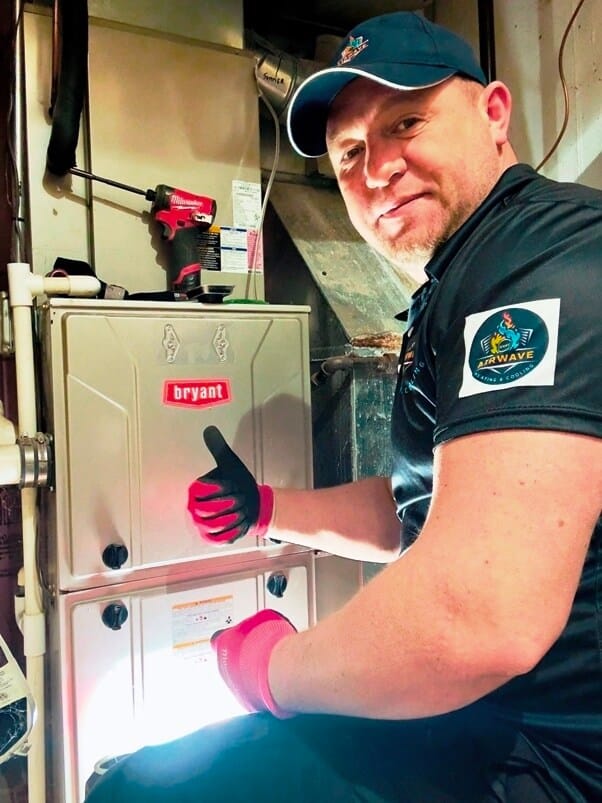
Founder & Principal Technician
Igor Talmazan
HVAC Contractor & Founder · Airwave Heating and Cooling
Airwave's furnace and heating repair work is performed personally by Igor Talmazan — an Illinois-licensed HVAC contractor who built the company's service protocols specifically around the combustion-safety realities of residential gas furnaces. Every furnace service call in McHenry County receives combustion analysis with carbon monoxide measurement in the supply airstream — the definitive heat exchanger safety test — at no extra charge. Many local operators offer this as an upcharge or skip it entirely; Airwave treats it as the non-negotiable baseline of furnace service, because the alternative is asking a homeowner to take a contractor's word on whether their family is being exposed to carbon monoxide.
Every furnace repair follows a documented diagnostic protocol that emphasizes ignition-system testing, gas valve verification, flue-and-condensate integrity, and combustion-safety confirmation before any repair recommendation. The compensation structure does not change between a $80 flame-sensor cleaning and a $5,000 system replacement — the recommendation is driven by what combustion analysis and visual inspection actually find, not by which option produces the larger invoice. Combined with stocked parts for the brands prevalent in McHenry County homes, this produces a single-visit repair rate that is the working definition of what Airwave is known for.
- Illinois HVAC Contractor License — verifiable through IDFPR public lookup
- Combustion analysis on every furnace service call — supply-airstream CO measurement, documented in writing, no extra charge
- Fully insured residential HVAC operations across McHenry County
- Written itemized estimate before any furnace repair work begins — never surprises on the invoice
- No commission on equipment sales — repair-vs-replace recommendations driven by combustion findings and the math
- Common parts stocked on the service vehicle — igniters, flame sensors, pressure switches, capacitors, condensate pumps, control boards for major brands
IL HVAC License: #PF1C707231CB6F1L0 · Service area: Lake in the Hills, Crystal Lake, Algonquin, Cary, Huntley, Carpentersville, and surrounding McHenry County communities.
Fast Track Service
Schedule Furnace service in McHenry County
Share a few details and we'll call you back to confirm your appointment — usually within the hour. Or skip the form: (773) 849-7379
Request Received!
We'll call you back shortly to confirm your appointment.
For an emergency during the heating season, don't wait — call us now.
Your information is used only to schedule your service call — never shared or sold.
Other HVAC Services in McHenry County
Same licensed technician, same direct service — across all HVAC needs.
AC Repair
Same-day air conditioning diagnostics and repair. EPA 608 certified refrigerant handling for R-22, R-410A, and R-454B systems.
AC Repair →Furnace Installation
New furnace installation with proper Manual J load calculation. Existing-system removal and disposal included.
Furnace Installation →HVAC Maintenance
Fall furnace tune-ups that prevent the repairs catalogued above. Multi-point inspection and combustion analysis on every visit.
HVAC Maintenance →Ready to Schedule Furnace Repair in McHenry County?
Same-day service for non-emergencies, 24/7 dispatch for no-heat situations during the heating season. Direct technical contact — no call-center routing.
Common Questions
Furnace & Heating Repair FAQ — McHenry County, IL
Honest answers to the questions McHenry County homeowners ask most about furnace repair, combustion safety, and what to expect on a service call.
The most common causes, in order of likelihood: a failed igniter (the hot-surface element that lights the burner), a fouled flame sensor (the rod that confirms ignition — when fouled, the control board closes the gas valve as a safety measure), a tripped pressure switch (the safety switch that confirms the inducer is producing draft), or a tripped high-limit switch (typically from airflow restriction). Less common: failed control board, dead transformer, or gas supply issue. Most of these are same-day repairs. Check the thermostat (set to HEAT, setpoint above room temperature, fresh batteries) and the breaker (reset once if tripped) before calling.
That pattern — burner ignites, runs briefly, then shuts down — is almost always a fouled flame sensor. The sensor confirms the burner is producing flame; when carbon deposits insulate the rod, the signal drops below the threshold the control board needs, and the gas valve closes as a safety measure. Cleaning the flame sensor is the most common single-visit furnace repair we perform in McHenry County, typically $80–$150 and resolved in 20–30 minutes. Less common causes: pressure switch flutter (inducer not producing stable draft), low gas pressure at the meter, or a control board grounding issue.
Common repair ranges: flame sensor cleaning $80–$150, igniter replacement $150–$300, pressure switch $80–$200, run capacitor $80–$180, condensate drain clearing $80–$150, gas valve $250–$550, blower motor $350–$650 (PSC) or $500–$900 (ECM), control board $350–$700, inducer motor $400–$800. Combustion analysis with carbon monoxide measurement is included free on every furnace service call — never billed separately. A written itemized estimate is provided before any work begins. See the full pricing table above for all repair types.
For furnaces under 15 years old with combustion analysis confirming the heat exchanger is intact, repair is almost always the right call. For furnaces 15+ years old, the conversation requires combustion analysis first. If the heat exchanger is intact and the failed component is serviceable, repair often still makes sense. If combustion analysis flags elevated CO in the supply airstream or visual inspection reveals visible cracks, replacement is the only safe path forward. The age-and-efficiency math also matters: an 80% AFUE system 14+ years old facing $1,000+ in repairs often pays back its replacement cost within 7–10 years through operating-cost savings. We provide both numbers openly and earn no commission either way. See the full decision framework above.
Yes — a cracked heat exchanger is the most serious furnace safety failure that exists. The heat exchanger physically separates combustion gases (including carbon monoxide) from the air your family breathes. A crack allows CO into the supply airstream and through the home. Heat exchangers cannot be reliably repaired — even welded repairs are not certified for safety, and most manufacturers explicitly void warranty on a system with a repaired heat exchanger. When combustion analysis or visual inspection confirms a crack, the safe path is replacement (heat exchanger only if under warranty and economically justified, otherwise full system replacement). This is non-negotiable. Every Airwave furnace service call includes documented heat exchanger inspection with combustion analysis — at no extra charge.
The most common explanation is harmless: accumulated summer dust burning off the heat exchanger during the first heating cycle of the season. The smell typically dissipates within 15–30 minutes of operation and does not return. If the burning smell persists more than an hour, smells acrid or electrical (versus dusty), or returns on subsequent heating cycles, that's not normal — shut the furnace down and call. Possible causes of persistent burning smell: melting wire insulation (electrical fire risk), oil residue on a new component, dust burning off a high-limit switch that's tripping too frequently, or — rarely — a refractory crack in the burner area. Combustion analysis identifies any safety-significant condition immediately.
AFUE (Annual Fuel Utilization Efficiency) measures what percentage of the fuel your furnace burns is converted into useful heat. 80% AFUE means 80% of the fuel becomes heat in your home; 20% leaves through the flue. Most furnaces installed in McHenry County before 2010 are 80% AFUE. High-efficiency systems (90–95%) and premium-efficiency systems (95%+) are increasingly common in newer installations. AFUE matters for the repair-vs-replace conversation: an 80% AFUE system 14+ years old facing $1,000+ in repairs has both a repair cost and an ongoing efficiency penalty — annual fuel savings of $200–$450 from upgrading to 95%+ can recover the install difference within 7–10 years. See the AFUE guide above.
Yes. Health-priority routing applies to households with elderly residents, infants and young children, or family members with cold-sensitive medical conditions during winter weather advisories. These calls move to the front of the dispatch queue when temperatures are below 20°F or a cold-advisory is in effect. Carbon monoxide detector alarms and gas leak symptoms also receive immediate priority dispatch any hour. Direct line at (773) 849-7379 — no call-center routing, no callback queue. After-hours rates are stated upfront when you call, not added afterward.
Yes — Airwave is based in Lake in the Hills and provides same-day furnace repair throughout McHenry County. Response time is typically same-day for non-emergencies and within hours for 24/7 emergency no-heat calls during winter weather advisories. If you're searching "furnace repair near me" from a McHenry County address, Airwave is likely within a 10–20 minute drive of your home. We service every primary community — Lake in the Hills, Crystal Lake, Algonquin, Cary, Huntley, and Carpentersville — plus surrounding county addresses and Fox River Grove. Call (773) 849-7379 and we'll verify coverage for your specific address before scheduling.
Most furnace repairs are completed in a single visit, typically 60–120 minutes total — diagnostic, combustion analysis, written estimate, repair, and verification. Common parts are stocked on the service vehicle: igniters, flame sensors, capacitors, pressure switches, condensate pumps, and control boards for major brands. Exceptions that may require a second visit: control boards for less common brand/model combinations, manufacturer-specific OEM blower motors, and gas valves for older discontinued furnaces — typically sourced same-day or next-day from local supply houses. Most McHenry County calls have heat restored the same day the technician arrives.
Last reviewed: June 2026 · EPA 608 refrigerant phase-out dates, repair pricing ranges, and IL HVAC licensing verified current.