
Lake in the Hills, IL — Airwave's Home Community
Furnace Repair in
Lake in the Hills, IL
★★★★★
5.0 · Google reviews ↗
Airwave provides licensed gas furnace and heating repair throughout Lake in the Hills — same-day for standard calls, 24/7 emergency response. Airwave is headquartered here, so response times for a deep-cold emergency are the fastest in the county. Combustion analysis and a written estimate are included on every call.
Airwave HQ · Fastest local response
Combustion analysis included
24/7 Emergency
IL HVAC License
Illinois HVAC License
#PF1C707231CB6F1L0 ↗
On Every Call
Combustion Analysis
Google Reviews
5.0 · Verified ↗
Headquartered
Lake in the Hills, IL
Coverage
Both Counties · Same-Day
Furnace Brands We Service:
Carrier
Lennox
Trane
Goodman
Rheem
Bryant
American Standard
York
Amana
Local Diagnostic Patterns
The 1990s Building Boom Meets 2010s High-Efficiency — Two Furnace Waves Aging Together
Lake in the Hills built out largely between 1985 and 2005, producing a wave of original furnaces — predominantly 80% AFUE single-stage equipment — that has now been almost entirely replaced. The replacement wave installed during the 2005–2015 cycle produced a concentrated population of 90%+ AFUE high-efficiency furnaces, and that second wave is itself now reaching the 15–20 year mark where component failures start cascading.
The practical implication is that "the typical Lake in the Hills furnace" is no longer a 1990s 80% AFUE unit — it's a 2008-vintage high-efficiency condensing furnace with an inducer motor, pressure switch, hot-surface igniter, and condensate drain that all have predictable end-of-life patterns at 15–20 years. Knowing that this is the dominant local equipment generation shortens diagnostic time and ensures the right parts are on the service vehicle before the call.
📍
Home-Base Advantage
Fastest Deep-Cold Response in the Village
Airwave is headquartered in Lake in the Hills, so service calls here don't involve a drive in from a neighboring city. For a no-heat emergency on a 4°F January night — particularly in a home with elderly residents or young children — the difference between a 20-minute local response and a 60-minute cross-county drive can mean pipes freezing or a household sleeping in coats.
Local addresses receive the fastest possible response in the entire McHenry County service area, simply by virtue of geography.
🔄
2005–2015 Replacement Wave
The Current Dominant Equipment Generation
Most of the original 1990s 80% AFUE furnaces installed during the building boom have already been replaced — typically between 2005 and 2015, often paired with AC replacement at the same time. That replacement cycle installed a concentrated population of 90%+ AFUE condensing furnaces with two-stage or modulating burners, which is now the dominant equipment generation across Lake in the Hills.
This equipment is currently 10–20 years old and entering its component-failure window — inducer motors, pressure switches, hot-surface igniters, and flame sensors all follow predictable end-of-life patterns at this age.
⚡
Synchronized Component Failures
When Subdivisions Were Built Together, They Fail Together
Spring Creek Farms, Trails of Boulder Ridge, Olde Salem, and Wynnfield — built within roughly the same window — also had their furnaces replaced in roughly the same window. That synchronization continues to the next failure cycle: igniters from 2008 don't fail one at a time across a decade; they fail in concentrated waves during the same winter or two of each other.
The practical implication is that when one neighbor calls about a no-start furnace, the immediate question is whether a half-dozen other subdivision homes are due for the same repair. Service vehicle stock reflects this.
💧
High-Efficiency Condensate
Drain Considerations on 90%+ AFUE Equipment
The 90%+ AFUE condensing furnaces installed during the 2005–2015 replacement wave produce significant liquid water as a combustion byproduct. After 15+ years of service, condensate traps accumulate biofilm and sediment, drain lines partially clog, and auxiliary condensate pumps reach the end of their service life.
The diagnostic emphasis on winter service calls includes checking the condensate trap, drain routing, and any auxiliary pump — particularly for Woods Creek Lake-adjacent homes where higher ambient humidity drives condensate volume to the top of the expected range.
❄️
Winter Vent Termination Icing
PVC Intake & Exhaust on Sidewall Installations
High-efficiency furnace installations in the village's subdivision builds typically use sidewall PVC pipes for combustion intake and exhaust. During deep-cold periods with heavy snow, these terminations can ice over — particularly on north-facing walls. The inducer can't establish proper draft, the pressure switch never closes, and the furnace locks out.
Mid-winter vent freezes are one of the most common Lake in the Hills no-heat calls, and one of the easiest to misdiagnose when a technician doesn't physically inspect the exterior terminations.
🔧
Parts Stocked for the Local Fleet
The Brands & Components Local Homes Actually Have
The brands and specific failure-prone components in the village's 2005–2015 replacement-wave installations are well-documented after years of local service. Hot-surface igniters, flame sensors, pressure switches, inducer motors, capacitors, and condensate components for the dominant brands are stocked on the service vehicle.
The practical result: most local furnace calls complete in a single visit, without a return trip to source a part a less locally-familiar contractor wouldn't have carried.
Local Service Mix
Furnace Repairs We See Most Often in Lake in the Hills
Three repairs account for the majority of heating-season calls in the village — and all three connect directly to the dominant 2005–2015 high-efficiency equipment generation. The full diagnostic guide for all furnace failure types is on the Furnace Repair hub page.
Most common · #1
Hot-Surface Igniter Failure — Synchronized 2005–2015 Wave
Hot-surface igniters in the dominant local equipment generation have typical 5–7 year service lives, and replacement-wave furnaces installed during the same construction phase tend to fail in concentrated waves. Many local homes have already had their second or third igniter replacement; equipment installed around 2008 is often on its third generation of igniter by 2026.
Diagnosis: Continuity testing across the igniter terminals. Replacement parts stocked on the service vehicle. Typical cost: $150–$300 same-visit.
IgnitionSame-visit2005–2015 wave
#2
Flame Sensor Fouling — Universal Pattern
Flame sensors detect the burner flame and signal the control board to keep the gas valve open. Carbon and oxide buildup on the sensor surface reduces the signal below the lockout threshold, and the furnace shuts down within seconds of ignition. This is the single most common winter no-heat call across every Lake in the Hills equipment generation.
Diagnosis: Visual inspection and signal measurement. Cleaning is straightforward; replacement when the sensor is degraded. Typical cost: $80–$200 same-visit.
IgnitionSame-visitAll eras
#3
Inducer Motor & Pressure Switch — Aging High-Efficiency
Inducer motors and pressure switches on the 2005–2015 replacement-wave high-efficiency furnaces are now 10–20 years old and reaching end-of-life. Symptoms include the furnace starting but failing to ignite, intermittent lockouts, or short cycling. Local synchronization means these components fail in waves across nearby subdivision homes.
Diagnosis: Inducer current-draw analysis, pressure switch continuity testing, hose verification. Typical cost: Pressure switch $200–$400; inducer motor $400–$800.
High-efficiencySame-visit2005–2015 wave
When a local homeowner searches "furnace repair near me", the nearest licensed option is almost always Airwave — the company is based in the village itself, not a city away. Direct technical contact at (773) 849-7379.
What We Fix Locally
Gas Furnace Repair Services in Lake in the Hills, IL
Every service below is performed under Airwave's Illinois HVAC contractor license, with combustion analysis and heat exchanger inspection included on every call. A written itemized estimate is provided before any work begins. Common parts are stocked on the service vehicle.
Whether you're searching for furnace repair near you in Spring Creek Farms, Trails of Boulder Ridge, Olde Salem, or anywhere else in the village, every service below applies to your address.
Combustion Analysis & Heat Exchanger Inspection
Digital combustion analyzer testing of CO, oxygen content, and combustion efficiency. Visual heat exchanger inspection on every service call — borescope used when standard visual access is restricted. Standard practice, not an add-on.
Included on every service callHot-Surface Igniter Replacement
The single most common 2005–2015 replacement-wave repair. Continuity testing, igniter replacement, and burner cycle verification before service is complete. Stocked on the vehicle for same-visit completion across the major brands prevalent in the village.
Igniter: $150–$300 same-visitInducer Motor & Pressure Switch
Diagnosis and replacement for 90%+ AFUE high-efficiency furnaces — the dominant equipment generation locally. Inducer current-draw analysis, pressure switch continuity testing, verification of vent terminations and intake/exhaust hoses.
Inducer: $400–$800 · Pressure switch: $200–$400Flame Sensor Service
Flame sensor cleaning or replacement — the dominant winter no-heat call across all equipment generations. Signal measurement, surface cleaning when degradation is mild, or full replacement when the sensor is at end-of-life.
Flame sensor: $80–$200Gas Valve & Burner Service
Gas valve diagnosis, manifold pressure verification, burner cleaning. Particularly relevant for any local furnace that has accumulated 15+ years of service without burner cleaning — dirty burners produce inefficient combustion, elevated CO output, and accelerated heat exchanger wear.
Burner service: $150–$350 · Gas valve: $300–$600Control Board & Thermostat Diagnosis
Output testing and continuity verification before any board replacement. Thermostat issues eliminated first — boards are expensive and frequently misdiagnosed by less-rigorous service approaches as the cause of intermittent problems.
Thermostat: $150–$350 · Board: $350–$700Blower Motor Service
PSC and ECM blower motor diagnosis and replacement. Capacitor testing first on PSC systems — a working motor paired with a failing capacitor is a common over-service we avoid by testing the cheaper component first.
PSC blower: $300–$650 · ECM blower: $450–$900Condensate Drain Service
High-efficiency furnace condensate line clearing, trap inspection, biofilm removal, and auxiliary pump diagnosis. Particularly relevant for Woods Creek Lake-adjacent homes where ambient humidity drives condensate volume higher than inland addresses.
Drain service: $80–$20024/7 Emergency No-Heat Response
Mid-winter no-heat failures receive priority dispatch any hour — and because dispatch originates from a local address rather than a city away, response times here are typically the fastest in McHenry County. Health-priority routing for cold-sensitive households during deep-cold periods.
After-hours rates disclosed upfrontTransparent Pricing
Furnace Repair Costs in Lake in the Hills, IL
Typical residential gas furnace repair cost ranges. A written itemized estimate is provided before any work begins — you approve the cost before we proceed. No surprises on the invoice.
If you're comparing furnace repair pricing near you in Lake in the Hills, these are the same ranges Airwave quotes throughout the village — no zone-based pricing, no surcharge for any neighborhood.
Hot-surface igniter — most common repair on 2005–2015 equipment
$150 – $300
Flame sensor cleaning / replacement — universal winter pattern
$80 – $200
Pressure switch replacement
$200 – $400
Vent termination thaw / clearing
$80 – $150
Condensate drain clearing
$80 – $200
Thermostat replacement
$150 – $350
Burner cleaning / service
$150 – $350
Gas valve replacement
$300 – $600
Inducer motor replacement
$400 – $800
Blower motor — PSC standard
$300 – $650
Blower motor — ECM variable-speed
$450 – $900
Control board replacement
$350 – $700
Heat exchanger replacement (vs. system replacement)
$1,200 – $2,500+
- Combustion analysis and heat exchanger inspection are included on every service call — not separate line items.
- A written estimate with itemized part and labor costs is provided before any work begins.
- After-hours rates apply to calls after 6 PM, before 8 AM, and weekends/holidays — stated upfront when you call, not added after the fact.
- When a heat exchanger crack is identified, we tell you immediately — and provide both repair and replacement numbers honestly. For 2005–2015 wave equipment now 15–20 years old, the math frequently favors full system replacement over a heat exchanger swap.
Fastest Response in the Village
24/7 Emergency Furnace Repair in Lake in the Hills
Mid-winter no-heat failures in northern Illinois are emergencies — particularly when indoor temperatures would drop dangerously low overnight or when the home includes cold-sensitive residents. Airwave dispatches 24/7 throughout the heating season, and because dispatch starts from a local address rather than a city away, response times here are typically the fastest in McHenry County.
When you search "emergency furnace repair near me" at 11 PM on a 4°F night, the call goes directly to a licensed technician at the local number — and the response originates from inside the village. (773) 849-7379.
Carbon Monoxide Symptoms Are Not a Furnace Repair Call — They Are a 911 Call
If you smell exhaust gas, your CO detector is alarming, or anyone in the home has unexplained headaches, dizziness, or nausea while the furnace is running — get everyone out of the home immediately and call 911 from outside. After the home is cleared and emergency services have confirmed it safe to re-enter, then call us for diagnosis. Do not attempt to operate the furnace until a licensed technician has inspected it.
Direct Line to a Licensed Technician — Any Hour
No call-center routing, no callback queue. After-hours rates are stated upfront when you call, not added afterward. Health-priority routing for cold-sensitive residents during deep-cold periods.
Local emergency calls are typically reached within 20–40 minutes from initial contact, depending on time of day and the technician's current call location.
Before We Arrive — Steps to Take Right Now
- 1If anyone has CO symptoms or the detector is alarming: evacuate immediately and call 911 from outside the home.
- 2Confirm thermostat is set to HEAT, setpoint above current room temperature, fan to AUTO.
- 3Reset the furnace power switch (usually a red toggle near the furnace) once if you suspect a lockout. Repeated lockouts mean leave it off.
- 4Check the air filter — replace it if more than 60 days old. A clogged filter is the leading cause of high-limit lockouts.
- 5If you have a high-efficiency furnace, check exterior PVC vent terminations for snow or ice blockage and clear them if safe to reach.
- 6Move cold-sensitive household members to interior rooms with closed doors — small spaces hold residual heat longer.
How a Service Call Works
Same-Day Furnace Repair in Lake in the Hills — From Call to Completed Repair
Four steps, one licensed technician, no hand-offs. The full technical diagnostic protocol is documented on the Furnace Repair hub.
When you search "furnace repair near me" from a Lake in the Hills address and call Airwave, here's exactly what happens — combustion analysis included, no surprises.
01
Direct Call — Technical Contact
You speak directly with the licensed technician who will handle your call — no call center, no callback queue. Local calls receive priority routing as Airwave's home community.
02
On-Site Diagnostic + Combustion Analysis
System operation interview, electrical measurement, combustion analysis with digital analyzer, heat exchanger inspection, and root-cause identification — documented before any repair recommendation.
03
Written, Itemized Estimate
Parts-and-labor cost presented in writing before any work begins. You approve the cost. No surprises on the invoice. For 2005–2015 wave equipment with multiple component concerns, both repair and replacement options are presented with honest numbers.
04
Repair Completed Same Visit
Common parts stocked on the service vehicle — flame sensors, igniters, pressure switches, inducer motors, capacitors. Most local calls complete in the initial visit with no return trip required, and combustion verified safe before we leave.
Coverage
Airwave Serves Every Lake in the Hills Neighborhood — Our Home Community
Airwave is headquartered in Lake in the Hills and dispatches every service call from a local address. No section of the village has reduced service availability or slower response times — local knowledge of each neighborhood's original builder, replacement-wave timing, and typical equipment age is built into the diagnostic approach for every address.
Primary Lake in the Hills Neighborhoods Served
- Spring Creek Farms — 1990s subdivisions, replaced 2005–2015
- Trails of Boulder Ridge — established residential, mature canopy
- Olde Salem & vicinity — Woods Creek Lake-adjacent
- Wynnfield — 1990s build, high-efficiency replacement wave
- Lakewood Hills — established subdivision
- Cosman Park area — central village residential
- Plum Tree / Hidden Lakes — newer subdivisions
- All other village neighborhoods — same standards, same response
From Spring Creek Farms to Hidden Lakes, every village neighborhood is genuinely "near" Airwave — the company is based in the village — and gets the same response time, same combustion analysis, same written-estimate-first approach.
Live in a surrounding McHenry County community not listed above? Reach Airwave at (773) 849-7379 — coverage and timing for your specific address is confirmed before scheduling.
Furnace Repair Near Me in Lake in the Hills — Why Local Matters in Deep Cold
When a Lake in the Hills homeowner searches for furnace repair on a 4°F January night, the practical question is who can be at the address quickly with the right parts. Airwave is headquartered in the village itself — closer than any large regional HVAC chain dispatching from Schaumburg, Elgin, or Arlington Heights.
Being based locally produces three concrete advantages for "near me" callers: (1) direct technical contact when you call rather than dispatcher triage and callback queues, (2) a fully-stocked service vehicle that handles the large majority of local calls in a single visit — because the brands and failure-prone components in the village's 2005–2015 replacement-wave equipment are well-documented after years of local service, and (3) response times that don't depend on highway conditions during a winter storm. The dispatch originates from inside the village.
For homeowners comparing options, the relevant question is who picks up the phone, who actually shows up, and whether combustion is verified safe before the technician leaves. Airwave's 5.0 rating across 47 verified Google reviews speaks to the outcome. The first two are answered by calling.
Licensed & Insured Furnace Repair
Licensed & Insured Furnace Repair in Lake in the Hills
Airwave Heating and Cooling is headquartered in this village. Founder and principal technician Igor Talmazan personally handles every local furnace service call — there is no dispatch layer between you and the technician who shows up.
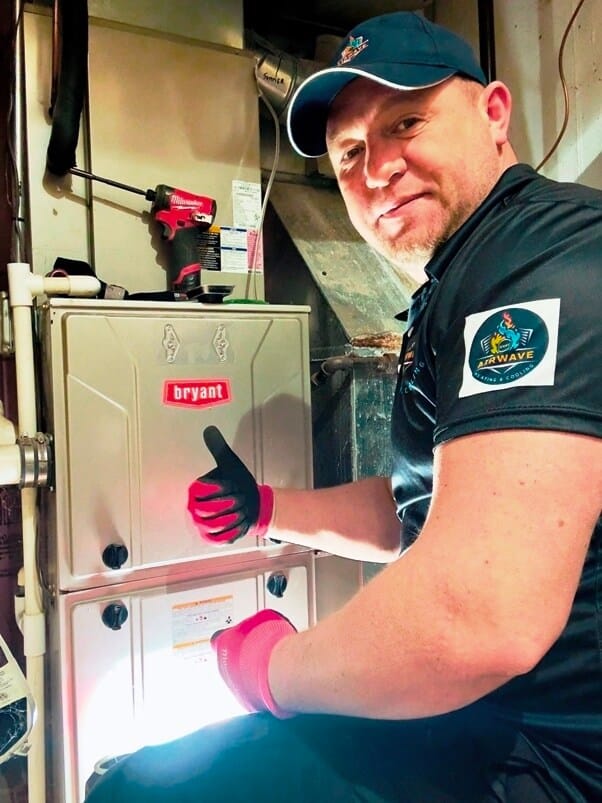
Founder & Principal Technician
Igor Talmazan
HVAC Contractor & Founder · Airwave Heating and Cooling
This is the community Airwave is built around. Igor founded the company in Lake in the Hills, service is dispatched from a local address, and the diagnostic standards established for residential furnace work reflect a level of familiarity that only comes from working the same housing stock for years. The 1990s building boom installed an original wave of 80% AFUE furnaces that has now been almost entirely replaced — typically between 2005 and 2015 — by 90%+ AFUE high-efficiency condensing equipment. That second wave is now the dominant local equipment generation, and it's reaching the 15–20 year mark where component failures start cascading: igniters, flame sensors, pressure switches, and inducer motors all follow predictable end-of-life patterns at this age, and synchronization across the subdivisions means concentrated failure waves rather than isolated events.
Combustion analysis and heat exchanger inspection are standard on every service call, not an upcharge or a "premium" tier. Gas appliance work doesn't responsibly end any other way — verifying CO output, oxygen content, and heat exchanger integrity before leaving the home is the only way to confirm safe operation. The compensation structure does not change between a $150 flame sensor cleaning and a $5,200 furnace replacement, so recommendations follow what the diagnostic readings actually show.
- Illinois HVAC Contractor License — verifiable through IDFPR public lookup
- Combustion analysis on every service call — not an upcharge
- Heat exchanger inspection standard, with borescope when needed
- Fully insured residential HVAC operations
- Written itemized estimate before any work begins
- No commission on equipment sales — recommendations driven by the math
IL HVAC License: #PF1C707231CB6F1L0 · Direct technical contact at (773) 849-7379. Local dispatch — fastest response in the village.
Fast Track Service
Schedule Furnace service in Lake in the Hills, IL
Share a few details and we'll call you back to confirm your appointment — usually within the hour. Or skip the form: (773) 849-7379
Request Received!
We'll call you back shortly to confirm your appointment.
For an emergency during the heating season, don't wait — call us now.
Your information is used only to schedule your service call — never shared or sold.
Other HVAC Services in Lake in the Hills
Same licensed technician, same direct service — across all heating, cooling, and indoor comfort needs.
AC Repair
Same-day air conditioning diagnostics and repair in Lake in the Hills. Refrigerant management for R-22, R-410A, and R-454B systems under EPA 608 certification.
AC Repair →Furnace Installation
New high-efficiency furnace sizing and installation — particularly relevant for 2005–2015 wave equipment now approaching replacement. AFUE selection appropriate to McHenry County's heating climate.
Furnace Installation →HVAC Maintenance
Annual fall tune-ups that extend the service life of aging equipment. Combustion analysis and heat exchanger inspection on every visit.
HVAC Maintenance →Ready to Schedule Furnace Repair in Lake in the Hills?
Same-day service for non-emergencies, 24/7 dispatch for deep-cold no-heat failures. Combustion analysis included on every call. Local dispatch — fastest village response.
Nearby Furnace Repair Pages
Furnace Repair Near Lake in the Hills — Adjacent McHenry County Cities
Same licensed technician, same combustion analysis standard across the McHenry County service area surrounding the village.
Common Questions
Furnace Repair FAQ — Lake in the Hills, IL
Honest answers to the questions Lake in the Hills homeowners ask most about furnace repair, response timing, and what to expect from a service call in our home community.
Airwave is headquartered in Lake in the Hills — every dispatch starts from a local address. Response times here are typically the fastest in the McHenry County service area: 20–40 minutes for emergency calls during deep-cold periods, depending on the technician's current call location. Same-day scheduling is standard for non-emergency calls. Direct technical contact at (773) 849-7379 — no call-center routing.
Likely yes, and not because anything is wrong with your specific furnace — it's the synchronized-aging pattern. The 90%+ AFUE replacement-wave equipment installed across the village's subdivisions during the same construction window now sees component failures in concentrated waves rather than spread evenly across time. Hot-surface igniters typically last 5–7 years, so an igniter failure at 18–20 years suggests the furnace is on its second or third generation of igniter. Other components on the same equipment vintage — flame sensor, pressure switch, inducer motor, condensate pump — are statistically more likely to fail in the next 2–4 years than the same components on newer equipment. Annual fall maintenance catches degrading components before they fail on a 4°F night.
If your Lake in the Hills furnace genuinely dates to the original 1990s build, it's now 30+ years old and well beyond the typical service life. Most original equipment was replaced during the 2005–2015 cycle, so an original 1990s unit still in service is unusual — and the math almost always favors replacement at this point. The deciding factors: (1) heat exchanger condition — a crack on equipment this age means replacement, not heat exchanger swap. (2) Refrigerant if the AC was paired (R-22 systems carry steep recharge costs). (3) Efficiency — a new 96%+ AFUE unit will produce meaningfully lower heating bills compared to an 80% AFUE original. We provide both repair and replacement numbers honestly, and Airwave earns no commission on equipment sales, so the recommendation reflects the math.
A furnace that ignites, runs briefly, then shuts down is almost always a flame sensor problem — the single most common winter no-heat pattern in Lake in the Hills across every equipment generation. Carbon and oxide buildup on the sensor surface reduces the flame signal below the lockout threshold, the control board interprets the missing signal as a flame failure, and the gas valve closes. The blower may continue running briefly to clear residual heat. Secondary causes include a marginal hot-surface igniter degrading mid-cycle, a pressure switch hose issue, or a high-limit trip from restricted airflow. Cleaning or replacing the flame sensor is a $80–$200 same-visit repair and resolves the vast majority of these calls.
Most local calls fall in the $80–$400 range. The three most common: hot-surface igniter replacement $150–$300 (the dominant replacement-wave repair), flame sensor cleaning or replacement $80–$200 (universal pattern), and pressure switch replacement $200–$400. Larger repairs — inducer motor, blower motor, control board — range $400–$900. Combustion analysis and heat exchanger inspection are included on every call, not separate line items. See the full pricing table above.
Airwave is headquartered in Lake in the Hills — there is no contractor closer to you. Same-day scheduling is standard during heating season for non-emergency calls, and 24/7 emergency response applies for deep-cold no-heat failures. Most local calls are completed in a single visit because the service vehicle is stocked for the 2005–2015 replacement-wave equipment that dominates the village's furnace inventory. Call (773) 849-7379 for direct technical contact. Coverage and timing are confirmed before scheduling.
The blower is running but the burners aren't producing heat — several likely causes. Thermostat fan set to ON instead of AUTO causes the blower to run continuously without a heat call; switch to AUTO first. Flame sensor or igniter failure means burners aren't lighting; the blower runs but no burner ignition cycle. Closed gas valve at the furnace; confirm the gas shutoff is open. Tripped high-limit switch from a clogged filter; replace if more than 60 days old. Pressure switch lockout on high-efficiency systems; check exterior PVC vent terminations for snow or ice blockage. Persistent cool-air-only operation is a burner or ignition fault that needs diagnosis. Most are same-visit repairs.
Last reviewed: June 2026 · EPA 608 refrigerant phase-out dates, repair pricing ranges, and IL HVAC licensing verified current.